How to Select Butt Weld Pipe Fittings Based on Pressure, Temperature, and Fluid Type
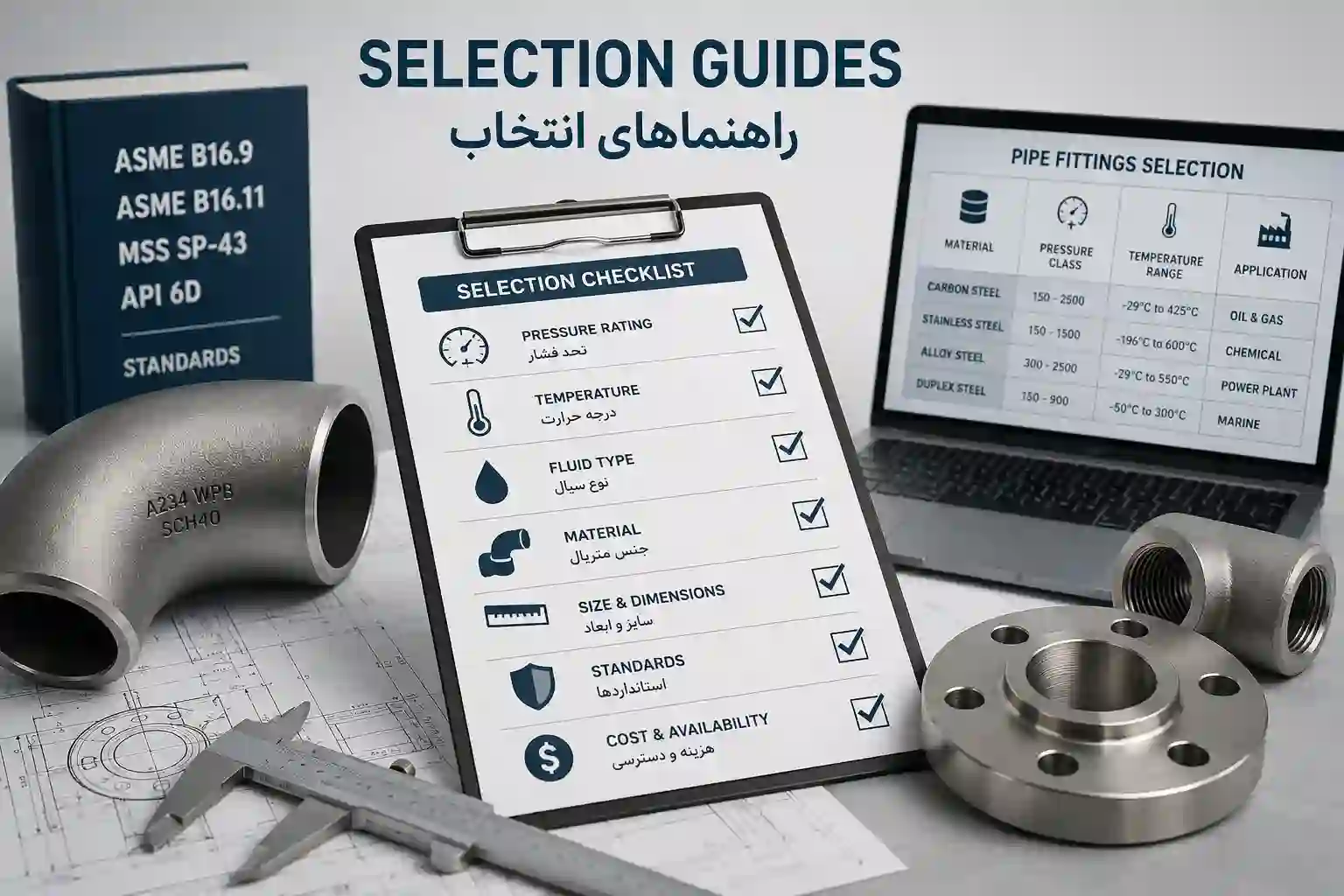
How to Select Butt Weld Pipe Fittings Based on Pressure, Temperature, and Fluid Type
Introduction
The selection of butt weld pipe fittings is one of the most critical engineering decisions in the design of industrial piping systems. A properly selected fitting ensures safe operation, long service life, and compliance with international codes. An incorrectly selected fitting can lead to catastrophic failure, costly downtime, and serious safety hazards.
This article provides a systematic, engineering-based methodology for selecting butt weld pipe fittings based on three primary parameters: pressure, temperature, and fluid type. The guidance is applicable to oil and gas, petrochemical, power generation, and general industrial applications.
All recommendations reference the latest editions of applicable standards including ASME B16.9, ASME B31.3, ASME B31.1, and relevant ASTM material specifications. The article is intended for mechanical engineers, piping designers, procurement engineers, and EPC contractors.
Why Proper Pipe Fitting Selection Matters
Industrial piping systems operate under extreme conditions. Fittings must withstand internal pressure, thermal expansion, mechanical loads, and chemical attack. The consequences of improper selection include:
- Leaks and loss of containment
- Catastrophic rupture under pressure
- Stress corrosion cracking
- Erosion and wall thinning
- Fatigue failure due to thermal cycling
- Unplanned shutdowns and production losses
- Safety hazards to personnel and equipment
For a deeper understanding of the standards governing butt weld fittings, refer to our comprehensive guide on ASME B16.9.
Common Engineering Mistakes
Even experienced engineers can make errors in fitting selection. The most frequent mistakes include:
- Incorrect pressure rating: Using fittings with insufficient wall thickness for the design pressure.
- Ignoring temperature derating: Failing to account for reduced material strength at elevated temperatures.
- Material mismatch: Selecting a material that is incompatible with the fluid, leading to corrosion or embrittlement.
- Wrong schedule: Using a pipe schedule that does not match the fitting wall thickness.
- Overlooking erosion: Not considering velocity and particle erosion in high-flow or abrasive services.
- Neglecting thermal expansion: Failing to account for thermal stresses in high-temperature systems.
These errors can be avoided by following a structured selection procedure, which is detailed later in this article.
Understanding Pressure Classes
Pressure is the most fundamental parameter in fitting selection. The fitting must have sufficient wall thickness and material strength to contain the operating pressure with an adequate safety margin.
Design Pressure vs Operating Pressure
Design Pressure is the maximum pressure that the piping system is designed to withstand under normal operating conditions, including any anticipated surges. It is typically specified by the process engineer and must be at least 10% higher than the maximum operating pressure, or as required by the applicable design code.
Operating Pressure is the normal pressure at which the system operates. The design pressure must always exceed the operating pressure to provide a safety margin.
| Parameter | Definition | Typical Margin |
|---|---|---|
| Operating Pressure | Normal steady-state pressure | Baseline |
| Design Pressure | Maximum pressure including surges | ≥ 110% of operating pressure |
| MAWP | Maximum Allowable Working Pressure | Calculated per ASME B31.3 |
Maximum Allowable Working Pressure (MAWP)
MAWP is the maximum pressure at which a piping component can operate safely at a given temperature. For butt weld fittings, the MAWP is determined by the wall thickness, material strength, and geometry, and is calculated using the design equations in ASME B31.3. The MAWP must exceed the design pressure to ensure safe operation.
Pressure Safety Margin
Engineers should apply a safety margin to account for uncertainties in pressure calculations, pressure surges, and potential overpressure events. A common practice is to design for a pressure at least 10–15% above the maximum expected operating pressure. In critical services, higher margins are recommended.
Pressure Cycling and Surge Pressure
Piping systems often experience pressure fluctuations due to pump startup, valve closure, or rapid changes in flow. These transient pressure spikes, known as surge pressure or water hammer, can be significantly higher than the steady-state operating pressure. When selecting fittings, engineers must account for these transient loads using methods such as Joukowsky's equation for water hammer.
Temperature Considerations
Temperature affects both the mechanical properties of the fitting material and the thermal expansion of the piping system. The selection process must consider both the design temperature and the operating temperature.
High Temperature Service
At elevated temperatures, the yield strength and tensile strength of most steels decrease. The allowable stress values provided in ASME B31.3 are temperature-dependent. For carbon steel fittings (ASTM A234 WPB), the temperature limit is typically 800°F (427°C). Above this temperature, alloy steel or stainless steel fittings are required.
Creep becomes a significant design concern at temperatures above 700°F (371°C) for carbon steel. In creep service, the fitting must be designed to withstand long-term deformation under constant stress.
Cryogenic Service
At very low temperatures, carbon steel becomes brittle and loses impact toughness. For temperatures below -20°F (-29°C), low-temperature carbon steel fittings per ASTM A420 WPL6 are required. For temperatures below -50°F (-46°C), austenitic stainless steel fittings (ASTM A403) are typically used.
Thermal Expansion and Thermal Fatigue
Piping systems expand and contract with temperature changes. Thermal expansion induces stresses in fittings, which can lead to fatigue failure if not properly managed. Flexible piping arrangements and expansion loops are often required to accommodate thermal movement.
| Temperature Range | Material Grade | Applicable Standard |
|---|---|---|
| Below -50°F (-46°C) | Stainless Steel (304/316) | ASTM A403 |
| -50°F to -20°F (-46°C to -29°C) | Low-Temp Carbon Steel | ASTM A420 WPL6 |
| -20°F to 800°F (-29°C to 427°C) | Carbon Steel | ASTM A234 WPB |
| 800°F to 1100°F (427°C to 593°C) | Alloy Steel (WP11, WP22) | ASTM A234 |
| Above 1100°F (593°C) | Stainless Steel / High-Alloy | ASTM A403 |
Fluid Classification
The type of fluid being transported is a critical factor in fitting selection. Different fluids have different corrosion, erosion, and compatibility characteristics. The fluid classification also determines the required material grade, inspection level, and corrosion allowance.
Steam
High-temperature, high-pressure steam requires carbon steel or alloy steel fittings. Erosion is a concern at high velocities.
Natural Gas
Dry gas is generally non-corrosive. Carbon steel fittings are suitable. Wet gas may require corrosion-resistant materials.
Hydrogen
Requires materials resistant to hydrogen embrittlement. Stainless steel or low-alloy steel with NACE MR0175 compliance.
LPG / LNG
Cryogenic or low-temperature service. Requires low-temp or stainless steel fittings.
Crude Oil
May contain corrosive compounds (H₂S, CO₂). Requires corrosion allowance or corrosion-resistant alloys.
Sea Water
Highly corrosive to carbon steel. Requires duplex stainless, super duplex, or high-grade stainless steel.
Acids / Alkalis
Highly corrosive. Requires stainless steel (316L) or nickel alloys such as Inconel or Hastelloy.
Slurry / Abrasive
Erosion is a major concern. Requires thicker walls and erosion-resistant materials.
For a comprehensive analysis of the global steel market for butt weld fittings, see our market analysis.
Material Selection
Material selection is one of the most complex aspects of fitting selection. The material must be compatible with the fluid, withstand the operating temperature and pressure, and be suitable for the manufacturing process.
Carbon Steel — ASTM A234 WPB
ASTM A234 WPB is the most common material for butt weld fittings. It is suitable for temperatures from -20°F to 800°F and is used in a wide range of services including oil, gas, water, and steam. It offers good strength and is relatively economical.
Low-Temperature Carbon Steel — ASTM A420 WPL6
WPL6 is used for services down to -50°F. It provides good impact toughness at low temperatures and is commonly used in LNG, cryogenic gas plants, and cold-weather applications.
Stainless Steel — ASTM A403
Stainless steel fittings (304, 316, 304L, 316L) are used in corrosive services, high-temperature applications (>800°F), and where product purity is essential. Grade 316L offers enhanced corrosion resistance, particularly against chlorides.
Duplex and Super Duplex
Duplex stainless steels offer a combination of high strength and excellent corrosion resistance. They are used in offshore, subsea, and high-chloride environments.
| Material | Standard | Temp Range (°F) | Typical Applications |
|---|---|---|---|
| Carbon Steel (WPB) | ASTM A234 | -20 to 800 | Oil, gas, water, steam |
| Low-Temp (WPL6) | ASTM A420 | -50 to 650 | LNG, cryogenic, cold climates |
| Stainless 304/304L | ASTM A403 | -320 to 1500 | Food, pharmaceuticals, general corrosion |
| Stainless 316/316L | ASTM A403 | -320 to 1500 | Chloride, marine, chemical |
| Alloy Steel (WP11, WP22) | ASTM A234 | Up to 1100 | High-temperature, refinery |
| Duplex (2205) | ASTM A860 | -50 to 600 | Offshore, seawater, chemical |
Selecting Pipe Schedule
The pipe schedule determines the wall thickness of the pipe and fittings. The schedule must be selected based on the design pressure, temperature, and corrosion allowance. Common schedules include SCH 10, 20, 40, 80, 160, and XXS.
For a given pressure, the required wall thickness increases with pipe diameter. Higher schedules provide greater wall thickness and higher pressure capacity but also increase weight and cost.
Choosing the Correct Fitting Type
Each fitting type serves a specific function in a piping system. Selection depends on the required change in direction, branch connection, or diameter reduction.
90° and 45° Elbows
Elbows are used to change the direction of flow. 90° elbows and 45° elbows are the most common. Long radius (LR) elbows are preferred for most applications due to lower pressure drop and reduced erosion. Short radius (SR) elbows are used where space is limited. For a detailed comparison of LR vs SR elbows, refer to our dedicated guide.
Tees — Equal and Reducing
Tees are used to create branch connections. Equal tees have the same diameter as the run. Reducing tees have a branch diameter smaller than the run. Branch connections must be properly reinforced to maintain pressure integrity.
Reducers — Concentric and Eccentric
Reducers are used to transition between different pipe sizes. Concentric reducers maintain a common centerline. Eccentric reducers maintain a flat bottom or top, which is important for drainage and avoiding liquid accumulation.
Caps and Stub Ends
Caps are used to close the end of a pipe. Stub ends are used with lap joint flanges to create flanged connections where welding to the flange is not desired.
Inspection Requirements
Inspection is essential to verify that fittings meet the specified requirements and are free from defects. The level of inspection depends on the service criticality.
- PMI: Positive Material Identification to verify material grade.
- UT: Ultrasonic testing for internal defects.
- RT: Radiographic testing for weld and material integrity.
- MT/PT: Surface testing for cracks and flaws.
- Hydrostatic Testing: Pressure integrity verification.
- Mill Test Certificate: Documentation of material properties and compliance.
For guidance on counterfeit detection, see our article on how to detect fake welding fittings.
Cost Considerations
While the initial purchase price is important, the total cost of ownership must be considered. This includes installation cost, maintenance cost, replacement cost, and downtime cost. In some cases, a more expensive material with better corrosion resistance may be more economical over the lifecycle of the system.
For procurement guidance, refer to our welding fittings procurement guide.
Engineering Decision Matrix
The following decision matrix provides a systematic method for selecting butt weld fittings based on pressure, temperature, and fluid type.
| Parameter | Low Pressure | Medium Pressure | High Pressure |
|---|---|---|---|
| Pressure Range | Up to 300 psi | 300–1500 psi | >1500 psi |
| Recommended Schedule | SCH 10–40 | SCH 40–80 | SCH 80–160 |
| Material | Carbon Steel | Carbon / Alloy | Alloy / Stainless |
| Inspection Level | Standard | Enhanced | Stringent |
Step-by-Step Engineering Selection Procedure
- Determine the design pressure and temperature from process data.
- Identify the fluid type and its corrosivity, erosion potential, and compatibility.
- Select the appropriate material grade based on temperature and fluid compatibility.
- Calculate the required wall thickness per ASME B31.3.
- Select the pipe schedule that meets or exceeds the calculated wall thickness.
- Choose the fitting type (elbow, tee, reducer, etc.) based on piping layout.
- Select the fitting radius (LR or SR) based on space and flow requirements.
- Specify the inspection and testing requirements.
- Document the selection in the piping material specification.
- Procure fittings with mill test certificates and traceability.
Real Engineering Examples
Example 1: High-Pressure Gas Pipeline
Service: Natural gas transmission. Pressure: 1200 psi. Temperature: 150°F. Material: ASTM A234 WPB. Schedule: SCH 80. Fitting: 90° LR elbow.
Example 2: Refinery High-Temperature Service
Service: Hot oil. Pressure: 600 psi. Temperature: 850°F. Material: ASTM A234 WP11 (Alloy Steel). Schedule: SCH 40. Fitting: Reducing tee.
Example 3: LNG Cryogenic Service
Service: LNG transfer. Pressure: 300 psi. Temperature: -260°F. Material: ASTM A403 WP304 (Stainless). Schedule: SCH 10. Fitting: Eccentric reducer.
Best Practices
- Always use the latest edition of ASME B16.9 and ASME B31.3.
- Verify material compatibility with the fluid using NACE MR0175 for sour service.
- Apply corrosion allowance based on expected service life.
- Use PMI to verify material grade upon delivery.
- Ensure traceability through proper marking and documentation.
- Consider future maintenance and replacement when selecting fittings.
For ongoing maintenance, see our maintenance and repair guide.
Future Trends
The selection of butt weld fittings is evolving with advancements in technology and the energy transition. Key trends include:
- Hydrogen Pipelines: Increased demand for fittings resistant to hydrogen embrittlement.
- Digital Engineering: AI-assisted selection and design optimization.
- Industry 4.0: Smart manufacturing and automated inspection.
- Decarbonization: Low-carbon steel and sustainable manufacturing.
For a broader perspective, read our pipe fittings market analysis.
Conclusion
The selection of butt weld pipe fittings is a multi-faceted engineering decision that requires careful consideration of pressure, temperature, fluid type, material compatibility, and applicable codes. By following a systematic methodology, engineers can ensure that fittings are safe, reliable, and cost-effective for the intended service.
For additional resources, visit our international products page or explore our comprehensive library of technical articles.
References & Frequently Asked Questions
References
Standards
- 1 ASME B16.9 — Factory-Made Wrought Buttwelding Fittings — American Society of Mechanical Engineers
- 2 ASME B31.3 — Process Piping — American Society of Mechanical Engineers
- 3 ASME B31.1 — Power Piping — American Society of Mechanical Engineers
- 4 ASME BPVC — Boiler and Pressure Vessel Code — American Society of Mechanical Engineers
- 5 ASTM A234/A234M — Piping Fittings of Wrought Carbon Steel and Alloy Steel — ASTM International
- 6 ASTM A420/A420M — Piping Fittings of Wrought Carbon Steel and Alloy Steel for Low-Temperature Service — ASTM International
- 7 ASTM A403/A403M — Wrought Austenitic Stainless Steel Piping Fittings — ASTM International
- 8 ASTM A860/A860M — Wrought High-Strength Ferritic Steel Buttwelding Fittings — ASTM International
- 9 API 5L — Specification for Line Pipe — American Petroleum Institute
- 10 API 570 — Piping Inspection Code — American Petroleum Institute
- 11 API 574 — Inspection Practices for Piping System Components — American Petroleum Institute
- 12 MSS SP-75 — High-Test Wrought Buttwelding Fittings — Manufacturers Standardization Society
- 13 MSS SP-43 — Wrought Stainless Steel Buttwelding Fittings — Manufacturers Standardization Society
- 14 ISO 15590-3 — Fittings for Pipeline Transportation Systems — International Organization for Standardization
- 15 ISO 15156 / NACE MR0175 — Materials for H₂S Environments — International Organization for Standardization / NACE International
Frequently Asked Questions
1. What is the most important factor when selecting butt weld fittings?
The most important factor is the combination of design pressure, design temperature, and fluid compatibility. The fitting must have sufficient wall thickness and material strength to contain the pressure at the operating temperature while resisting corrosion, erosion, or embrittlement from the fluid. All three parameters must be evaluated together.
2. How do I determine the correct pipe schedule for a fitting?
The pipe schedule is determined by the required wall thickness calculated from the design pressure and temperature using ASME B31.3 or B31.1 equations. The calculated wall thickness must include allowances for corrosion, erosion, and manufacturing tolerances. Once the required thickness is known, the nearest standard schedule (e.g., SCH 40, SCH 80) that meets or exceeds it is selected. The fitting schedule must match the pipe schedule.
3. What is the difference between long radius and short radius elbows?
Long radius (LR) elbows have a center-to-end dimension of 1.5 times the nominal pipe size and a radius of curvature equal to 1.5 times the NPS. Short radius (SR) elbows have a center-to-end dimension equal to the NPS and a radius of curvature equal to the NPS. LR elbows are preferred for most applications due to lower pressure drop, reduced erosion, and smoother flow. SR elbows are used where space is limited. For a detailed comparison, see our LR vs SR elbows guide.
4. When should I use stainless steel instead of carbon steel fittings?
Stainless steel fittings should be used when the fluid is corrosive, when the operating temperature exceeds 800°F (427°C) for carbon steel, when product purity is critical (e.g., food, pharmaceuticals), or when operating at cryogenic temperatures below -50°F. Stainless steel grades like 304/304L and 316/316L offer excellent corrosion resistance and maintain strength at both high and low temperatures.
5. What does ASTM A234 WPB mean and what is it used for?
ASTM A234 WPB is the standard specification for wrought carbon steel buttwelding fittings. The "WPB" stands for Wrought Pressure (Class B). It is the most common material for fittings used in oil, gas, water, steam, and general industrial services at temperatures between -20°F and 800°F. It offers good strength, weldability, and is cost-effective.
6. What is the difference between a concentric reducer and an eccentric reducer?
A concentric reducer maintains a common centerline and is used in vertical piping or where uniform flow distribution is desired. An eccentric reducer maintains a flat bottom or top and is used in horizontal piping to maintain proper drainage, prevent liquid accumulation, or ensure that entrained gases do not disrupt flow. The choice depends on the piping layout and fluid characteristics.
7. How do I account for corrosion in fitting selection?
Corrosion allowance is typically added to the calculated wall thickness to account for material loss over the expected service life. The corrosion allowance is specified by the process engineer based on the corrosivity of the fluid and the desired service life (usually 20–30 years). For highly corrosive fluids, a corrosion allowance of 1/16" to 1/8" may be used, or a corrosion-resistant alloy may be selected instead.
8. What is the difference between design pressure and operating pressure?
Operating pressure is the normal steady-state pressure during routine operation. Design pressure is the maximum pressure that the system is designed to withstand, including any anticipated surges or transients. Design pressure is always higher than operating pressure and is used as the basis for wall thickness calculations. A typical design margin is 10–15% above the maximum operating pressure.
9. What is MAWP and how is it calculated?
MAWP (Maximum Allowable Working Pressure) is the maximum pressure at which a piping component can safely operate at a given temperature. It is calculated using the design equations in ASME B31.3, considering the wall thickness, material allowable stress, and geometry. The MAWP must exceed the design pressure to ensure safe operation.
10. What is the purpose of hydrostatic testing for fittings?
Hydrostatic testing is performed to verify the pressure integrity of the piping system, including fittings. The system is pressurized with water (or another suitable liquid) to a pressure higher than the design pressure (typically 1.5 times design pressure) to ensure there are no leaks or structural weaknesses. This testing is conducted during commissioning and after any major repair work.
11. How does temperature affect the selection of fittings?
Temperature directly affects the allowable stress of the material. At elevated temperatures, material strength decreases, requiring thicker walls or a different material grade. At cryogenic temperatures, materials may become brittle, requiring low-temperature steels or stainless steels. Thermal expansion also induces stresses that must be considered in the piping design.
12. What are the inspection requirements for butt weld fittings?
Inspection requirements vary by service criticality. Standard inspections include dimensional checks, visual inspection, PMI (Positive Material Identification), and review of mill test certificates. For critical or high-pressure services, additional NDT such as UT (Ultrasonic Testing), RT (Radiographic Testing), MT (Magnetic Particle), and PT (Liquid Penetrant) may be required. Hydrostatic testing is often required for the assembled system.
13. When should I use a reducing tee instead of a straight tee with a reducer?
A reducing tee should be used when the branch connection is smaller than the run and the reduction in diameter can be achieved in a single fitting. This reduces the number of welds and fittings, saving cost and space. A straight tee with a separate reducer is used when the branch pipe size differs and a gradual transition is needed, or when a reducing tee is not available in the required size combination.
14. What are the common mistakes in selecting butt weld fittings?
Common mistakes include selecting the wrong material grade for the service conditions, choosing a fitting with insufficient wall thickness, ignoring temperature derating, mixing different schedules, failing to verify material compatibility, and not applying appropriate corrosion allowances. Always follow a systematic selection procedure and verify all parameters against the applicable standards.
15. How can I verify the quality of fittings upon delivery?
Upon delivery, perform a visual inspection for surface defects, check dimensional compliance, verify marking and traceability, and review mill test certificates. For critical services, perform PMI to confirm material grade. If any discrepancies are found, contact the supplier immediately. For more information, see our guide on detecting fake welding fittings.
16. What is the difference between ASME B16.9 and MSS SP-75?
ASME B16.9 defines dimensional requirements for standard-strength fittings. MSS SP-75 covers high-strength, high-test wrought buttwelding fittings with higher yield strength (52,000–80,000 psi) used in critical pipeline applications. Both standards define consistent dimensions, but MSS SP-75 fittings have enhanced material properties and additional inspection requirements.
17. How do I select fittings for hydrogen service?
Hydrogen service requires materials resistant to hydrogen embrittlement and hydrogen-induced cracking. Carbon steel fittings are generally not recommended for high-pressure hydrogen service. Stainless steel (304/316) or low-alloy steel meeting NACE MR0175/ISO 15156 requirements should be used. The fitting must be designed for the hydrogen partial pressure and temperature. For more insights, see our article on future trends.
18. What is the importance of material traceability?
Material traceability ensures that the material delivered matches the specified grade and heat number, enabling verification of chemical composition and mechanical properties. It is essential for quality assurance, regulatory compliance, and failure investigation. Traceability is achieved through proper marking (manufacturer name, grade, size, heat number) and documentation (mill test certificates).
19. How do I decide between a seamless and a welded fitting?
Seamless fittings are manufactured from a solid billet without a longitudinal weld seam, offering higher strength and better resistance to corrosion and pressure. Welded fittings are fabricated from welded pipe and are generally more economical. Seamless fittings are preferred for high-pressure, high-temperature, and critical services. Welded fittings are suitable for general applications. For a detailed comparison, see our article on seamless vs welded elbows.
20. What are the future trends in fitting selection?
Key trends include the increased use of digital engineering and AI-assisted design, the growing demand for fittings in hydrogen infrastructure, the adoption of low-carbon and green steel, and the integration of Industry 4.0 technologies for automated manufacturing and inspection. These trends are driving the development of new materials, smarter design tools, and more rigorous quality standards.
🌍 International Products
ASME B16.9
Iran Etesal Asia Steel Industries is a leading manufacturer of high-quality steel butt-weld fittings. With over 600 products in our portfolio, we serve industries including oil & gas, petrochemical, power generation, and water treatment.
All products are manufactured in compliance with ASME B16.9 and international standards, ensuring reliability, durability, and precision. Available in various sizes, schedules (SCH 20, SCH 40), and materials.
🧰 Piping Engineering Toolbox
30 Professional Tools30 professional tools for rapid calculations in the piping industry. All tools are designed based on ASME standards and are 100% free for engineers, designers, and industry professionals.