
Comprehensive Analysis of the Global Steel Market and Its Impact on the Butt Weld Fittings Industry
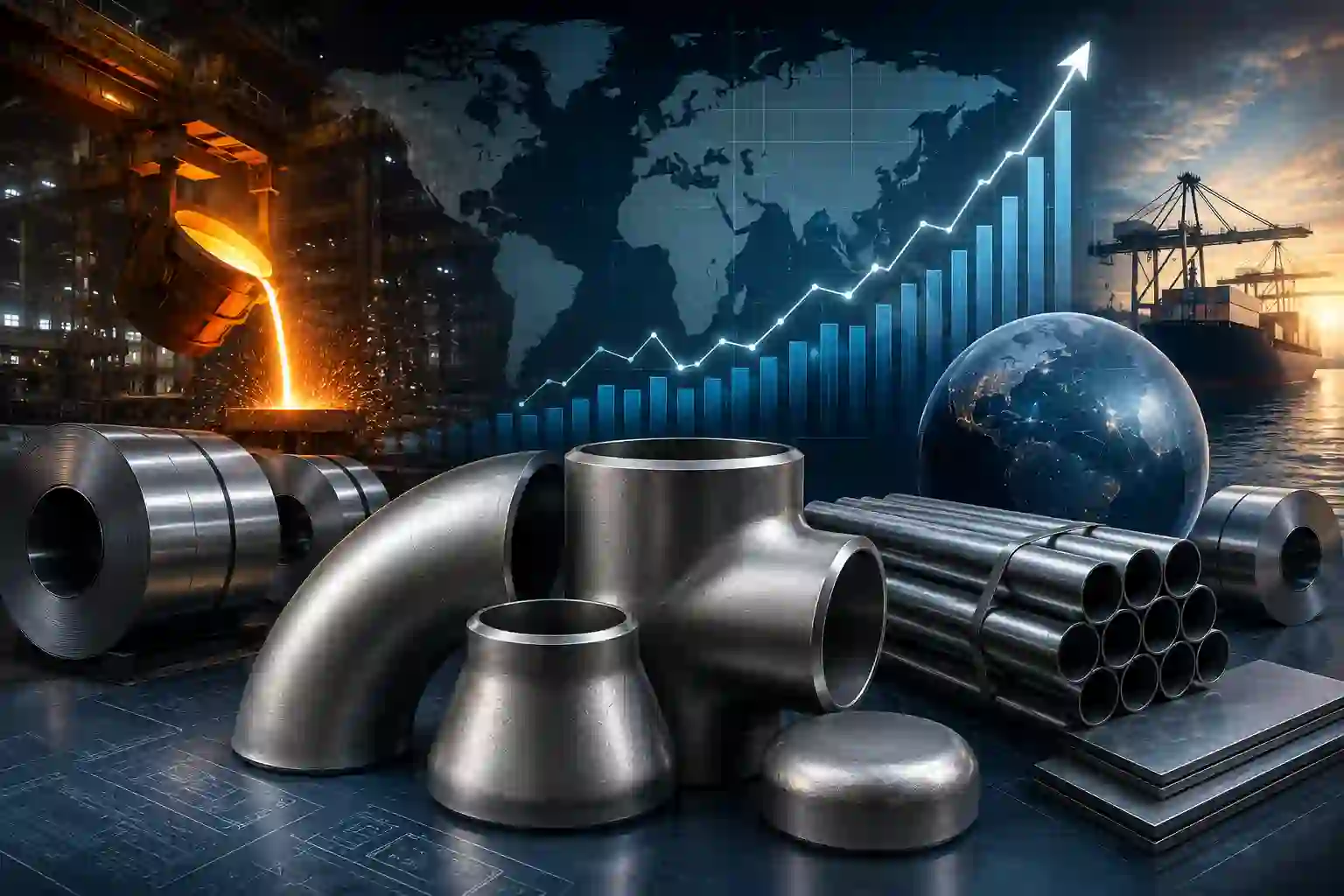
📊 Comprehensive Analysis of the Global Steel Market and Its Impact on the Butt Weld Fittings Industry
Comprehensive Technical and Economic Report · Updated: July 2026 · ⏱ Reading Time: 30 minutes
📌 Executive Summary
The global steel market in 2025 and 2026 is experiencing a period of transformation and restructuring. Global crude steel production reached 157.9 million tons in May 2026, showing a 0.3% decrease compared to May 2025 (World Steel Association, 2026).
The butt weld fittings industry, as one of the main consumers of steel products, is directly affected by steel price fluctuations and tariff changes. The global butt weld fittings market was valued at $606 million in 2025 and is projected to reach $849 million by 2032, growing at a CAGR of 5.0% (Fortune Business Insights, 2025).
Iran produced 7.26 million tons of crude steel in the first four months of 2026, ranking 10th globally (World Steel Association, 2026).
🔮 Outlook: With increasing investment in oil & gas projects and renewable energy, demand for butt weld fittings is expected to rise through 2030.
🌍 Global Steel Industry Overview
The steel industry, as one of the fundamental pillars of the global economy, plays a vital role in infrastructure development, automotive, construction, oil & gas, and energy industries. This industry faces numerous challenges including climate change, environmental regulations, raw material price volatility, and international trade trends.
1-1. Brief History
Steel production has grown significantly from the Industrial Revolution to the present day. In the 19th century, the Bessemer process revolutionized the industry. Today, more modern methods such as Blast Furnace (BF), Electric Arc Furnace (EAF), and Direct Reduced Iron (DRI) are dominant.
1-2. Major Steel Producers Worldwide
According to the latest data from the World Steel Association, global crude steel production in 2025 was approximately 1.88 billion tons. China accounts for over 53% of global production, making it the world's largest steel producer. Following China are India, Japan, the United States, and Russia.
| Rank | Country | Production (Million Tons) | Global Share (%) | Annual Change (%) |
|---|---|---|---|---|
| 1 | China | 998.0 | 53.1 | -2.1 |
| 2 | India | 128.0 | 6.8 | +4.5 |
| 3 | Japan | 90.0 | 4.8 | -0.8 |
| 4 | United States | 85.0 | 4.5 | +9.2 |
| 5 | Russia | 76.0 | 4.0 | +1.2 |
| 6 | South Korea | 67.0 | 3.6 | +0.5 |
| 7 | Turkey | 40.0 | 2.1 | +3.8 |
| 8 | Germany | 38.0 | 2.0 | -1.5 |
| 9 | Brazil | 32.0 | 1.7 | +2.0 |
| 10 | Iran | 29.0 | 1.5 | +1.8 |
| 11 | Italy | 24.0 | 1.3 | -0.2 |
| 12 | Vietnam | 22.0 | 1.2 | +27.2 |
| 13 | Mexico | 20.0 | 1.1 | +5.0 |
| 14 | France | 18.0 | 1.0 | -0.5 |
| 15 | Spain | 16.0 | 0.9 | +1.0 |
| 16 | Poland | 14.0 | 0.7 | +0.8 |
| 17 | Canada | 13.0 | 0.7 | +2.5 |
| 18 | Taiwan | 12.0 | 0.6 | -0.3 |
| 19 | United Kingdom | 10.0 | 0.5 | -1.0 |
| 20 | Egypt | 9.0 | 0.5 | +3.0 |
📌 Source: World Steel Association – 2025 Annual Data (with estimates for H1 2026)
Vietnam's remarkable growth (27.2%) reflects the country's extensive investment in the steel industry and infrastructure development. On the other hand, China's production decline (-2.1%) is due to pollution reduction policies and environmental restrictions.
1-3. Global Steel Consumption and Trade
Apparent steel consumption in 2025 was estimated at approximately 1.79 billion tons. China accounts for 50% of global consumption, making it the world's largest steel consumer. India and the United States follow in subsequent positions.
                %%{init: {"pie": {"textPosition": 0.5}, "theme": "base"} }%%
                pie showData
                    "China (53.1%)" : 53.1
                    "India (6.8%)" : 6.8
                    "Japan (4.8%)" : 4.8
                    "United States (4.5%)" : 4.5
                    "Russia (4.0%)" : 4.0
                    "South Korea (3.6%)" : 3.6
                    "Other (23.2%)" : 23.2
📌 Source: World Steel Association – 2025 Data
1-4. Raw Material Dependency
The steel industry is heavily dependent on the following raw materials:
- Iron Ore: Australia and Brazil are the largest producers of high-grade iron ore.
- Coking Coal: Australia, China, and the United States are the largest producers.
- Scrap: The primary feedstock for Electric Arc Furnaces (EAF).
- Energy (Natural Gas and Electricity): Energy costs account for up to 30% of total steel production costs.
1-5. Emerging Technologies in the Steel Industry
- Green Steel: Steel production using hydrogen instead of coal.
- Electric Arc Furnace (EAF): A more sustainable alternative to blast furnaces with lower energy consumption.
- Direct Reduced Iron (DRI): Production of sponge iron without using coke.
- Artificial Intelligence and Automation: Optimizing production processes and reducing waste.
🇮🇷 Iran Steel Industry Analysis
Iran's steel industry, as one of the country's largest non-oil industries, plays a significant role in GDP, employment, and non-oil exports. With vast iron ore and natural gas reserves, Iran has a significant comparative advantage in steel production.
2-1. Iran Steel Production Statistics
According to the World Steel Association report, Iran produced 7.26 million tons of crude steel in the first four months of 2026.
| Year | Crude Steel Production (Million Tons) | Annual Change (%) |
|---|---|---|
| 2020 | 29.0 | — |
| 2021 | 30.5 | +5.2 |
| 2022 | 31.8 | +4.3 |
| 2023 | 32.5 | +2.2 |
| 2024 | 33.0 | +1.5 |
| 2025 | 32.0 | -3.0 |
| 2026* | 7.26 | — |
📌 Source: World Steel Association – *Data for first four months of 2026
2-2. Challenges Facing Iran's Steel Industry
- International Sanctions: Restrictions on technology, equipment, and export markets.
- Electricity Shortages: Power outages in summer disrupt production.
- Natural Gas Shortages: Gas imbalances in winter limit production units.
- Logistics and Transportation: High domestic and export transportation costs.
- Currency Fluctuations: Direct impact on raw material and equipment import costs.
Despite challenges, Iran's steel industry still benefits from competitive advantages such as access to cheap natural gas, skilled labor, and strategic regional location. If sanctions are lifted, Iran's steel export potential to regional markets is very high.
🔧 Butt Weld Fittings Industry
Butt weld fittings are recognized as one of the most important components of piping systems in oil, gas, petrochemical, and power generation industries. These fittings include Elbows, Tees, Reducers, and Caps.
3-1. Main Standards for Butt Weld Fittings
- ASME B16.9: Standard for dimensions of steel butt weld fittings.
- MSS SP-75: Standard for heavy-wall butt weld fittings.
- ASTM A234: Standard for carbon steel fittings material.
- ASTM A420: Standard for low-temperature carbon steel fittings.
- ASTM A403: Standard for stainless steel fittings.
3-2. Global Butt Weld Fittings Market
The global butt weld fittings market was valued at $606 million in 2025. It is projected to reach $849 million by 2032, growing at a CAGR of 5.0%.
| Year | Market Value (Million USD) | Growth Rate (%) |
|---|---|---|
| 2025 | 606 | — |
| 2026 | 636 | +5.0 |
| 2027 | 668 | +5.0 |
| 2028 | 701 | +5.0 |
| 2029 | 736 | +5.0 |
| 2030 | 773 | +5.0 |
| 2031 | 811 | +5.0 |
| 2032 | 849 | +5.0 |
📌 Source: Fortune Business Insights, 2025
Growth in the butt weld fittings market is primarily driven by increased investment in oil & gas, power plants, and petrochemical projects. Additionally, water and wastewater transmission projects in developing countries contribute to this market's growth.
📈 Global Steel Price Analysis
Steel prices are influenced by multiple factors including global demand, raw material costs, exchange rates, trade tariffs, and transportation costs.
4-1. Steel Billet Price
Steel billet prices reached $472 per ton in June 2026, showing a 0.74% decrease month-over-month and an 11.45% decrease year-over-year (Trading Economics, 2026).
4-2. Rebar and Steel Sheet Prices
- Rebar: $630 per ton (0.79% monthly decrease).
- Hot Rolled Coil (HRC): $700 per ton.
- Cold Rolled Coil (CRC): $800 per ton.
- Beam: $750 per ton.
The decline in steel prices in the first half of 2026 is primarily due to reduced demand in China, increased US tariffs, and decreased transportation costs.
🔮 Global Steel and Butt Weld Fittings Market Forecast
5-1. 1-Year Forecast (2026-2027)
- Steel Prices: Expected to fluctuate between $450-500 per ton.
- Demand: With increased investment in infrastructure projects, global steel demand will grow by 3-4%.
- Butt Weld Fittings: Market will reach approximately $636 million with 5% growth.
5-2. 3-Year Forecast (2026-2029)
- Green Steel: Increased investment in hydrogen-based steel production (Green Steel).
- Butt Weld Fittings: Market growth to $736 million with 5% CAGR.
- Iran: If sanctions are lifted, Iran's steel production will reach 40 million tons.
5-3. 5-Year Forecast (2026-2031)
- Global Steel Production: Will reach 2 billion tons.
- Butt Weld Fittings: Market will reach $811 million.
- Renewable Energy: Increased demand for steel in wind and solar industries.
⚠️ Risk Analysis
6-1. SWOT Analysis
| SWOT | Description |
|---|---|
| Strengths | Vast iron ore reserves, cheap natural gas, skilled labor, strategic location |
| Weaknesses | Sanctions, electricity and gas shortages, currency fluctuations, outdated infrastructure |
| Opportunities | Sanctions relief, exports to neighboring countries, investment in green steel |
| Threats | International sanctions, raw material price volatility, climate change |
💰 Investment Opportunities
- High-Quality Butt Weld Fittings Manufacturing: Investment in producing fittings compliant with ASME B16.9 and ASTM A234 standards.
- Export to Neighboring Countries: Markets in Iraq, Turkey, UAE, and CIS countries.
- Green Steel: Investment in hydrogen-based steel production.
- Automation and Artificial Intelligence: Optimizing production processes and reducing costs.
- Renewable Energy Development: Reducing energy costs in steel plants.
📌 Conclusion and Strategic Recommendations
The global steel industry is on the brink of a major transformation. Green Steel, Artificial Intelligence, and Automation will be the three main pillars of the industry's future. Despite numerous challenges, Iran possesses significant competitive advantages that, if sanctions are lifted and investment in emerging technologies is made, could transform it into a leading hub for steel and butt weld fittings production in the region.
Key Recommendations
- Investment in Emerging Technologies: Using artificial intelligence and automation to reduce costs and improve quality.
- Diversification of Export Markets: Reducing dependence on limited markets and developing exports to neighboring countries.
- High Value-Added Products: Focusing on producing high-quality fittings compliant with international standards.
- Energy Management: Reducing energy consumption and investing in renewable energy.
- Workforce Skills Development: Training specialized workforce in steel and fittings.
📚 References
- World Steel Association. (2026). Global Steel Production Statistics – May 2026. Brussels: World Steel Association.
- Fortune Business Insights. (2025). Butt Weld Fittings Market Size, Share & Industry Analysis, 2025-2032. Pune: Fortune Business Insights.
- Trading Economics. (2026). Steel Billet Price – Historical Data. Retrieved from https://tradingeconomics.com
- S&P Global Commodity Insights. (2025). Steel Market Outlook 2025-2030. London: S&P Global.
- CRU Group. (2025). Global Steel Market Analysis – Q4 2025. London: CRU Group.
- International Energy Agency (IEA). (2025). Iron and Steel Technology Roadmap. Paris: IEA.
- Fastmarkets. (2026). Steel Price Indices – June 2026. London: Fastmarkets.
- SteelOrbis. (2026). Iran Steel Production and Export Data. Istanbul: SteelOrbis.
- World Bank. (2025). Commodity Markets Outlook – Steel. Washington: World Bank.
- International Monetary Fund. (2025). World Economic Outlook – Steel Demand Analysis. Washington: IMF.
- Iran Steel Producers Association (ISPA). (2026). Iran Steel Industry Annual Report 2025. Tehran: ISPA.
- United Nations Comtrade. (2025). Steel Trade Statistics. New York: UN.
🌍 International Presence
Iran Etessal Asia - Supplying High-Quality Industrial Fittings to Global Markets
🌐 Global Reach, Local Expertise
Iran Etessal Asia is a leading manufacturer and exporter of butt weld fittings and piping components. With over 20 years of experience, we serve the oil & gas, petrochemical, power generation, and water transmission industries worldwide.
- Products: Elbows, Tees, Reducers, Caps, Nipples, Bushings, and Butt Weld Fittings
- Standards: ASME B16.9, ASTM A234, ASTM A420, ASTM A403, MSS SP-75
- Materials: Carbon Steel, Stainless Steel, Alloy Steel, Duplex, Nickel Alloys
- Sizes: ½" to 48" (DN15 to DN1200)
- Export to: 30+ countries across Europe, Asia, Middle East, and Africa
Our products are manufactured under strict quality control and certified to international standards. We are committed to delivering reliability, durability, and precision in every fitting.
← Back to Home