
How to Identify Counterfeit Pipe Fittings?

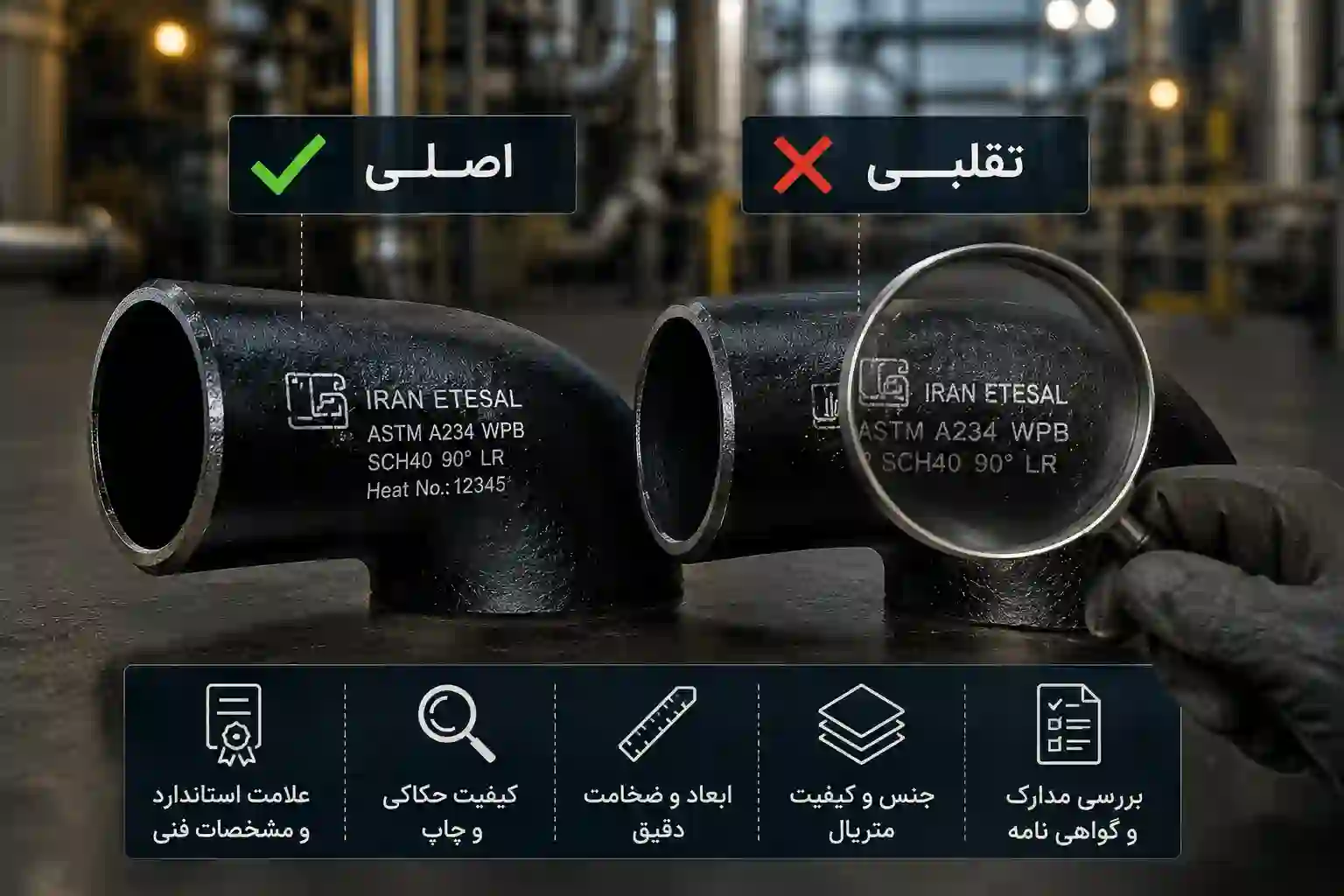
How to Detect Fake or Low-Quality Welding Fittings?
Comprehensive technical guide to identifying standard fittings from substandard products
Table of Contents
The market for welded steel fittings has faced an influx of cheap, low-quality products in recent years. Many of these products look similar to standard ones but can cause leaks, cracks, failures, and financial or human losses in industrial projects, gas and oil pipelines, petrochemical plants, and even building installations.
In this article, we review the most important methods for detecting standard welding fittings from fake or low-quality ones.
Why Are Low-Quality Fittings Dangerous?
In welded fittings, the entire system pressure passes through the joint. If material quality or manufacturing process is not adequate, the following issues may arise:
Technical Standards for Welding Fittings
Quality steel fittings must comply with one of the following recognized standards:
| Standard | Title | Application |
|---|---|---|
| ASTM A234 | Alloy and Carbon Steel Fittings | High temperature and pressure |
| ASME B16.9 | Dimensions of Welded Fittings | Dimensional control and tolerances |
| DIN 2605 / 2615 | Elbows and Reducers (German) | High precision and excellent quality |
| BS 1640 | Steel Fittings (British) | General industrial applications |
| ISO 9001 | Quality Management System | Quality assurance in production |
Material and Metallurgy Inspection
Fitting quality directly depends on steel grade and its manufacturing process:
Carbon Steel
Grades ST37, ST52, A106 with controlled carbon percentage
Alloy Steel
Grades WP5, WP9, WP11 resistant to high temperatures and corrosion
Heat Treatment
Annealing or normalizing to reduce internal stress
Specific Weight
Standard fittings have a specific weight; low-quality products are usually lighter
10 Key Methods to Detect Standard Fittings
Check the Marking
Engraved information on the body should include:
- Manufacturer name or brand
- Size (e.g., 6")
- Schedule (SCH40, SCH80)
- Manufacturing standard (ASTM A234, ASME B16.9)
- Material grade (WPB, WPC, ST37)
- Heat Number
ASTM A234 WPB
ASME B16.9
6" SCH40
Heat No. 2407-12
Measure Actual Thickness
A product might be sold as SCH40 but have a lower wall thickness than standard.
Tools: Caliper, Micrometer
Compare thickness with ASME B36.10 or B36.19 standard tables.
Check Fitting Weight
Standard fittings have a specific weight. Cheaper products usually have less thickness and lower weight.
If you place two identical elbows side by side, the standard one will typically be heavier.
Inspect Surface Quality
A standard fitting should have:
- ✅ Uniform surface
- ✅ No cracks
- ✅ No porosity
- ✅ No scaling
- ✅ No cavities
Check Thickness Uniformity
In low-quality products, thickness varies at different points. For example, one side of an elbow may be thick while the other is thin.
This creates issues during welding and causes localized stress.
Inspect Bevel Quality
The bevel at the end of the fitting must be completely uniform. If:
- Bevel angle is irregular
- Edge is wavy
- Bevel is incomplete
The welder will need to rework it, increasing time and cost.
Check Dimensions
Standard fittings must comply with dimensional standards. Key items:
- Outside Diameter (OD)
- Inside Diameter (ID)
- Center to End radius
- Center to End length
Any deviation will cause assembly problems.
Request Material Test Certificate (MTC)
For reputable industrial projects, the following documents must be provided:
- Material Test Certificate (MTC)
- Certificate of Conformity (COC)
These documents specify: chemical composition, mechanical properties, melt number, production standard.
Take Unusual Prices Seriously
If a product is priced significantly below market rates, one of these reasons likely applies:
- Lower thickness
- Inferior material
- Non-standard production
- No quality control
In industry, the cheapest option is not always the most economical choice.
Choose a Reliable Manufacturer
One of the safest approaches is to buy from manufacturers who:
- Have a proven production history
- Provide standard markings on their products
- Perform quality control
- Offer product traceability
- Provide technical documents
Quality Control and Technical Tests
🔬 Non-Destructive Testing (NDT)
- Radiography (X-Ray) – Detects internal bubbles and cracks
- Ultrasonic Testing – Measures thickness and defects
- Penetrant Testing (PT) – Detects surface cracks
- Hydrostatic Pressure Test – Verifies working pressure capacity
📋 Quality Control Documents
Each standard shipment must include a Mill Test Certificate containing:
- Exact chemical composition
- Mechanical properties (yield strength, elongation)
- NDT results
- Quality control officer signature
Standard Marking on Fittings
Standard fittings have engraved or embossed markings on the body:
ASTM A234 WPB
ASME B16.9
6" SCH40
Heat No. 2407-12
- Standard type: ASTM / DIN / BS
- Material grade: WPB, WPC, ST37, ST52
- Nominal size: in inches or millimeters
- Pressure class: SCH 40, SCH 80, 150#, 300#
- Brand: Reputable manufacturer name
Standard vs Fake Fitting Comparison
| Feature | Standard Fitting ✅ | Fake/Low-Quality Fitting ❌ |
|---|---|---|
| Marking | Engraved, complete, legible | Printed, faint, incomplete |
| Thickness | Matches SCH standard | Thinner than standard |
| Weight | Matches weight table | Lighter than normal |
| Surface Quality | Smooth, no cracks or cavities | Rough, with scale and cavities |
| Bevel | Uniform, precise angle | Irregular, wavy |
| Technical Documents | Includes MTC and COC | No documents provided |
| Material Grade | Controlled chemical composition | Poor quality, unknown composition |
Quick Purchase Checklist
- ✅ Complete, engraved marking
- ✅ Thickness compliant with standard
- ✅ Appropriate weight
- ✅ Excellent surface quality
- ✅ Uniform bevel
- ✅ Standard dimensions
- ✅ MTC certificate
- ✅ Reputable brand
- ✅ Standard marking present
- ✅ Reasonable price (not too cheap)
Iran Etessal: Leading Manufacturer
Iran Etessal with over two decades of experience, manufactures all products according to ASTM A234 and ASME B16.9 standards.
Identify quality by standard markings
View & Purchase Products Price & Size List
Final Summary
Detecting standard welded fittings is not possible by appearance alone. Checking marking, thickness, weight, surface quality, dimensions, bevel, material certificates, technical standards, and manufacturer credibility are the most important factors that can prevent purchasing fake or low-quality products.
This article is prepared to enhance technical awareness in identifying standard fittings.
2025 – All Rights Reserved.