
Long Radius (LR) vs Short Radius (SR) Elbow – Complete Technical Guide
Long Radius (LR) vs Short Radius (SR) Butt-Weld Elbow
Comprehensive Engineering Guide – Selection, Applications, Technical Specifications & Industry Insights
🔍 Introduction
The pipe elbow stands as one of the most critical and widely utilized components in industrial piping systems, engineered to redirect fluid flow within pipeline networks. This essential fitting enables the design of complex piping layouts without the need for direct pipe bending, playing a pivotal role in maintaining operational integrity, safety, and system reliability across diverse industrial applications.
The selection between a Long Radius (LR) and Short Radius (SR) elbow represents one of the most consequential decisions during the design and procurement phase of any piping project. This choice directly impacts pressure drop, flow velocity, mechanical stress distribution, installation footprint, project economics, and long-term service life of the entire system. A comprehensive understanding of these two elbow types empowers engineers and procurement specialists to make informed, project-optimized decisions.
This comprehensive technical dossier provides an in-depth examination of LR vs SR elbows, detailing their advantages, limitations, industrial applications, dimensional standards (ASME B16.9), and critical engineering specifications. Additionally, we address the distinction between seamless (SMLS) and welded (ERW) elbows, ensuring you possess the complete technical acumen required for optimal component selection.
🏭 Industrial Applications of Butt-Weld Elbows
Butt-weld elbows are indispensable across a broad spectrum of industries, owing to their superior mechanical strength, leak-tight integrity, and resilience under extreme pressure and temperature conditions. Primary sectors include:
🔹 Oil & Gas Sector
In crude oil transmission, natural gas pipelines, and refined product distribution networks, elbows facilitate directional changes across extensive overland and subsea routes. Long Radius (LR) seamless elbows are predominantly specified in these high-stakes applications to minimize pressure drop, reduce turbulence, and ensure uncompromised safety under high-pressure operating regimes.
🔹 Petrochemical & Refining Industry
Within refinery complexes and petrochemical plants, elbows form an integral part of extensive process piping networks, handling hydrocarbons, superheated steam, cooling water, and intermediate chemical streams. The diversity of chemical media and elevated process temperatures necessitate meticulous material selection and precise elbow specification to ensure corrosion resistance and long-term reliability.
🔹 Power Generation Facilities
In thermal, combined-cycle, and nuclear power stations, butt-weld elbows are deployed in superheated steam lines, boiler feedwater circuits, condensate return systems, and cooling water networks. The extreme pressure-temperature profiles characteristic of these applications demand high-integrity seamless elbows manufactured to the most rigorous quality standards.
🔹 Steel & Mining Industries
Steel mills, direct reduction plants, and mining operations utilize butt-weld elbows in process gas lines, slurry transport systems, and cooling circuits. The abrasive nature of many process streams and elevated operating temperatures necessitate heavy-wall elbows fabricated from wear-resistant materials.
🔹 Food & Pharmaceutical Processing
In sanitary processing environments, stainless steel elbows with electropolished internal surfaces and hygienic design standards are employed for the transfer of food products, dairy, beverages, and pharmaceutical intermediates where product purity and cleanability are paramount.
🔹 Other Critical Sectors
- Fire Protection Systems: Sprinkler networks and deluge systems
- Steam Distribution: Chemical processing and manufacturing plants
- Water & Wastewater: Municipal water supply and treatment facilities
- Industrial Hydraulics: Heavy machinery and industrial equipment
- Building Services: HVAC, heating, and chilled water systems
📐 Dimensional Standards – LR vs SR Elbows
Elbows are classified primarily by their bend radius, which determines the center-to-face dimension (Dimension A)—the critical measurement defining the elbow's curvature. Both LR and SR variants are manufactured in accordance with ASME B16.9 and are available in 45°, 90°, and 180° configurations.
🔹 Long Radius (LR) Elbow
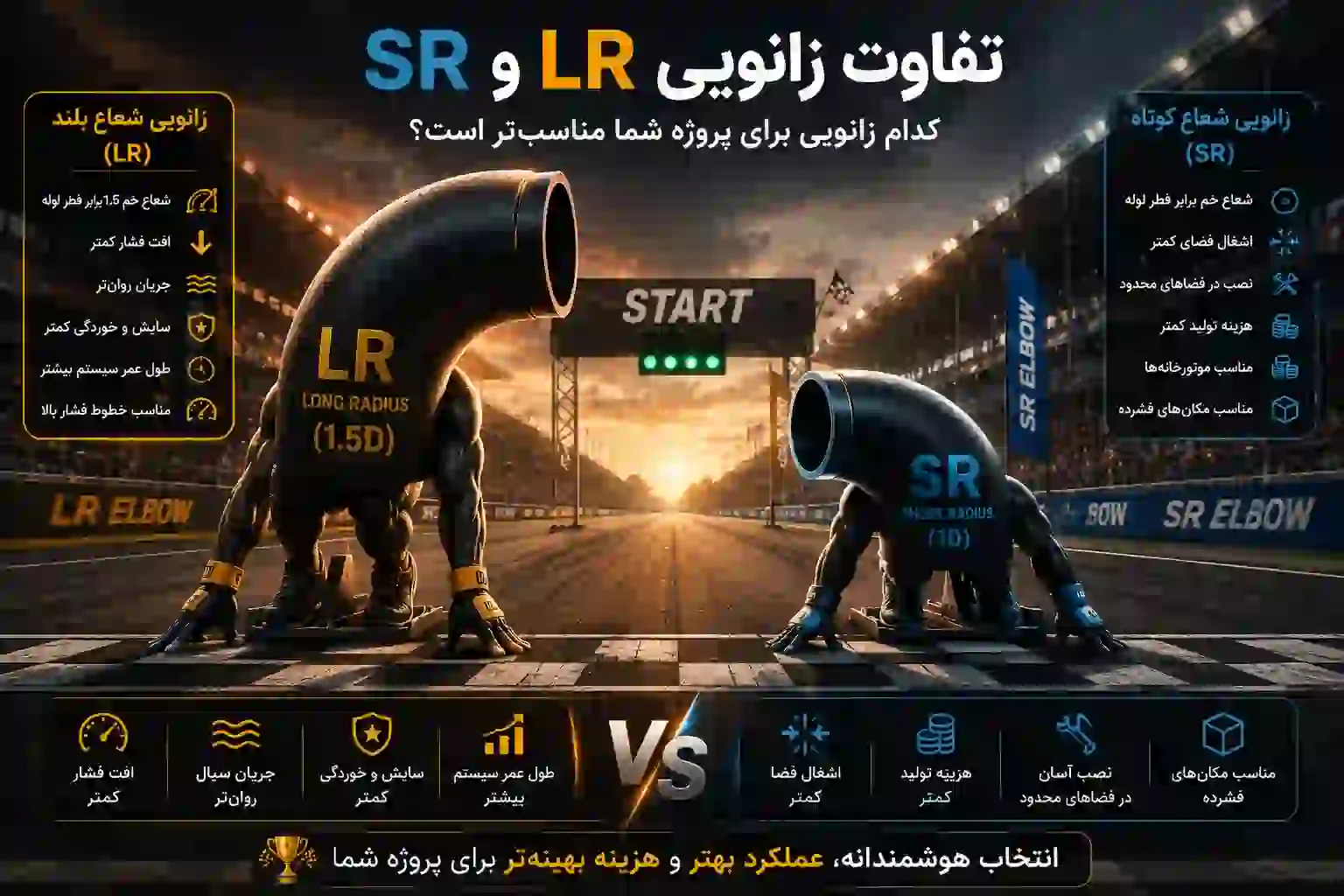
The Long Radius elbow (LR) is characterized by a center-to-face dimension equal to 1.5 times the nominal pipe size (1.5D). The increased bend radius results in reduced pressure drop, minimized flow turbulence, and superior hydraulic performance compared to its SR counterpart.
📌 LR Calculation Formula
A = 1.5 × NPS
Example – NPS 6 Pipe:
A = 1.5 × 6 = 9 inches (228.6 mm)
💡 Note: The 1.5D multiplier remains constant across all standard pipe sizes. In industrial practice, the LR elbow is universally regarded as the default specification for critical process applications.
🔹 Short Radius (SR) Elbow
The Short Radius elbow (SR) features a center-to-face dimension equal to 1.0 times the nominal pipe size (1D). This compact configuration offers a significantly reduced installation footprint but introduces higher pressure drop and increased flow turbulence relative to the LR design.
📌 SR Calculation Formula
A = 1 × NPS
Example – NPS 6 Pipe:
A = 1 × 6 = 6 inches (152.4 mm)
💡 Note: SR elbows are typically deployed in space-constrained installations where footprint optimization takes precedence over hydraulic efficiency.
📊 Comprehensive Comparison: LR vs SR Elbows
| Parameter | Long Radius (LR) | Short Radius (SR) |
|---|---|---|
| Bend Radius | 1.5 × NPS (1.5D) | 1.0 × NPS (1D) |
| Center-to-Face (A) | Larger (1.5D) | Smaller (1D) |
| Pressure Drop | ✅ Lower | ❌ Higher |
| Flow Turbulence | ✅ Reduced | ❌ Increased |
| Flow Resistance | ✅ Superior | ❌ Inferior |
| Installation Footprint | ❌ Larger | ✅ Smaller |
| Weight | Higher | Lower |
| Cost | Moderately Higher | Moderately Lower |
| Primary Application | Process & Transmission Lines | Space-Constrained Installations |
| Typical Industries | Oil, Gas, Petrochemical, Power | Utilities, Water, Wastewater |
| 🔹 Recommended Selection | ✅ Primary Choice for Critical Systems | ⚠️ Secondary Choice (Space-Limited) |
✅ Advantages & Limitations – LR vs SR
🔸 LR Elbow – Key Advantages
- Minimal Pressure Drop: The larger bend radius creates lower flow resistance, resulting in reduced pumping energy requirements and improved system efficiency.
- Enhanced Flow Characteristics: Fluid passes with reduced turbulence and superior hydraulic performance.
- Lower Mechanical Stress: The gradual directional change minimizes stress concentrations on the pipe wall at the bend region.
- Ideal for High-Viscosity Fluids: For heavy crude oils, bitumen, and other viscous media, LR elbows significantly reduce flow resistance.
- Reduced Erosion: In abrasive slurry or particulate-laden streams, the increased radius decreases wall erosion.
- Extended Service Life: Lower mechanical stress and reduced erosion contribute to enhanced system longevity.
🔸 LR Elbow – Limitations
- Larger Installation Footprint: Requires greater spatial clearance for installation.
- Increased Weight: The extended body length results in higher overall weight.
- Higher Cost: Additional material and manufacturing contribute to a slightly higher purchase price.
🔸 SR Elbow – Key Advantages
- Compact Footprint: Ideal for space-constrained environments where LR elbows cannot be accommodated.
- Reduced Weight: The shorter body length makes handling and installation simpler and more cost-effective.
- Lower Cost: Reduced material consumption yields a more economical price point.
- Low-Pressure Systems: Suitable for applications where pressure drop is not a critical design parameter.
🔸 SR Elbow – Limitations
- Higher Pressure Drop: The tighter radius creates increased flow resistance.
- Increased Turbulence: The abrupt directional change induces flow separation and turbulence.
- Elevated Mechanical Stress: The sharper bend produces higher stress concentrations at the intrados.
- Accelerated Erosion: In abrasive service, the tighter radius leads to increased wall erosion rates.
- Reduced Service Life: Higher stress and erosion contribute to shortened component life.
LR – Performance Advantages
Lower pressure drop • Smooth flow • Reduced mechanical stress • High-pressure capability • Extended lifespan
SR – Space-Saving Advantages
Reduced footprint • Lower weight • Cost-effective • Ideal for confined spaces • Low-pressure applications
Iran Etesal Asia – Quality Manufacturing
Manufacturing both LR and SR elbows to ASME B16.9 with premium materials and uncompromised quality
⚙️ Technical Specifications – Butt-Weld Elbows
| Specification | Value / Description |
|---|---|
| Designation | Pipe Elbow |
| Manufacturing Standard | ASME B16.9 |
| Connection Type | Butt Weld (BW) |
| Available Angles | 45°, 90°, 180° |
| Bend Radius | LR (1.5D) / SR (1D) |
| Material Grades | Carbon Steel, Stainless Steel, Alloy Steel, Low-Temperature Steel |
| Schedule Ranges | SCH 10, SCH 20, SCH 40, SCH 80, SCH 160, XXS |
| Manufacturing Method | Seamless (SMLS) / Welded (ERW) |
| Iran Etesal Asia Production | ✅ Certified & Approved |
🔩 Seamless (SMLS) vs Welded (ERW) Elbows – A Technical Comparison
Beyond the LR/SR distinction, elbows are further categorized by manufacturing method into seamless (SMLS) and welded (ERW) variants. This selection has direct implications on mechanical integrity, cost structure, and system longevity. The following provides a concise technical comparison:
💡 Key Distinction – Seamless vs Welded
🔹 Seamless (SMLS) Elbows: Fabricated from seamless pipe with no longitudinal weld seam. This eliminates potential weld-related failure points, delivering superior pressure-temperature ratings and enhanced corrosion resistance. The preferred specification for high-pressure, high-temperature, and critical service applications including oil & gas, petrochemical, and power generation. Carries a premium cost.
🔹 Welded (ERW) Elbows: Manufactured from welded pipe with a longitudinal seam weld. This cost-effective alternative provides satisfactory performance for moderate service conditions and is widely specified in utilities, water and wastewater, building services, and fire protection systems where cost optimization is a priority.
📌 Selection Criteria: The final choice must consider operating pressure, process temperature, corrosion resistance requirements, project standards, and budget constraints. Both variants, when manufactured to ASME B16.9, deliver reliable performance within their respective service envelopes.
📋 Elbow Selection Guidance – Project-Specific Recommendations
| Project Conditions | Recommended Selection | Technical Rationale |
|---|---|---|
| Oil, Gas & Petrochemical Process Lines | ✅ 90° LR Seamless Elbow | Minimal pressure drop, superior integrity, safety-critical |
| Space-Constrained Installation | ⚠️ SR Elbow (Seamless or Welded) | Optimizes available footprint |
| High-Pressure / High-Temperature Service | ✅ Seamless Elbow – Appropriate Schedule | Maximum mechanical strength and thermal stability |
| Corrosive Environments (Acids, Salts, etc.) | ✅ Stainless Steel Seamless Elbow | Superior corrosion resistance and pitting protection |
| Simultaneous Direction & Diameter Change | ⚠️ Reducing Elbow | Reduces component count and installation footprint |
| General Utility Service (Water, Air, etc.) | ✅ ASME B16.9 Elbow – Appropriate Schedule | Optimal balance of quality and cost-effectiveness |
| High-Pressure Steam Service | ✅ Seamless Elbow – SCH 80 or Higher | Ensures integrity under extreme pressure-temperature profiles |
| Budget-Constrained Projects | ⚠️ Welded Elbow – Standard Quality | Economical solution with acceptable performance |
📏 Center-to-Face Dimension Calculation (Dimension A)
The following demonstrates center-to-face dimension calculations for NPS 2 elbows:
📌 Sample Calculations – NPS 2
1. 90°-LR: A = 1.5 × 2 × 25.4 = 76.2 mm
2. 180°-LR: A = 2 × 76.2 = 152.4 mm
3. 90°-SR: A = 1 × 2 × 25.4 = 50.8 mm
4. 180°-SR: A = 2 × 50.8 = 101.6 mm
💡 Note: 25.4 is the inch-to-millimeter conversion factor. NPS denotes nominal pipe size.
| Elbow Type | Center-to-Face (A) – NPS 2 |
|---|---|
| 90° LR | 76.2 mm |
| 180° LR | 152.4 mm |
| 90° SR | 50.8 mm |
| 180° SR | 101.6 mm |
🛠️ Critical Engineering Considerations
🔹 Wall Thickness Integrity
A paramount consideration in elbow design and manufacturing is wall thickness control throughout the forming process. The intrados (inside radius) represents the region of maximum wall thinning, where material undergoes the greatest deformation during the bending operation.
Per ASME B16.9 requirements, the minimum elbow wall thickness shall not be reduced by more than 12.5% below the nominal pipe wall thickness. Maximum thickness tolerances are defined specifically at the welding bevel ends.
🔹 Up-Scheduling for Thickness Compensation
To compensate for wall thinning during forming, reputable manufacturers—including Iran Etesal Asia—frequently utilize one schedule higher pipe for elbow production. For instance, a Schedule 40 elbow may be manufactured from Schedule 80 pipe, ensuring that after forming and thinning, the final wall thickness remains within the specified Schedule 40 tolerance range.
⚠️ Critical Engineering Note
In high-pressure and high-temperature service, actual measured wall thickness is a critical verification parameter. Excessive thinning at the intrados can lead to reduced design life, accelerated fatigue, localized stress concentrations, and potential catastrophic failure of the piping system. This is why dimensional inspection and wall thickness verification are mandatory quality control steps in oil, gas, and petrochemical projects.
🎯 Final Conclusion & Decision Framework
The selection between Long Radius (LR) and Short Radius (SR) elbows must be driven by a comprehensive evaluation of project-specific parameters including available installation space, allowable pressure drop, fluid characteristics, mechanical stress limitations, and applicable design codes. Similarly, the choice between seamless and welded construction should reflect operating pressure, temperature, corrosion resistance requirements, and project economics.
✅ Executive Summary & Selection Guideline
🔹 LR Elbow: The preferred specification for oil & gas, petrochemical, power generation, and all critical high-pressure/high-temperature applications. Delivers lower pressure drop, smoother flow, reduced mechanical stress, and extended service life.
🔹 SR Elbow: The optimal solution for space-constrained installations, low-pressure utility systems, and projects where footprint optimization is the primary design driver. Provides a smaller installation envelope, reduced weight, and more economical pricing.
🔹 Seamless (SMLS): The standard of excellence for high-pressure, high-temperature, and corrosive service. Delivers superior mechanical integrity, no weld seam vulnerability, and maximum reliability.
🔹 Welded (ERW): The cost-effective alternative for moderate service conditions, general utility applications, and non-critical systems. Provides an attractive price-performance ratio with proven reliability.
🏭 Iran Etesal Asia – Your Trusted Partner in the Piping Industry
Premium Butt-Weld Elbows • Seamless & Welded • LR & SR • ASME B16.9 • Uncompromised Quality
Contact us for consultation and price inquiries.
📚 References & Technical Resources
-
📄 ASME B16.9 Standard – Factory-Made Wrought Butt-Welding Fittings – Dimensional data, tolerances, and technical specifications.
🔗 View on ASME Official Site -
📘 ASTM A234 Specification – Carbon Steel & Alloy Steel Fittings for Butt-Weld Service.
🔗 View on ASTM Official Site -
📙 ASTM A403 Specification – Stainless Steel Butt-Weld Fittings.
🔗 View on ASTM Official Site -
📗 Elbow Dimensional Data Sheet – Comprehensive LR & SR elbow dimensions across all NPS sizes.
🔗 View on Iran Etesal Asia -
📕 Butt-Weld Fittings Selection Guide – Engineering insights for optimal fitting selection.
🔗 View on Iran Etesal Asia