
Smart Factories in Butt Weld Fittings Manufacturing: The Role of Robotics, Artificial Intelligence, Digital Twins and Industry 4.0

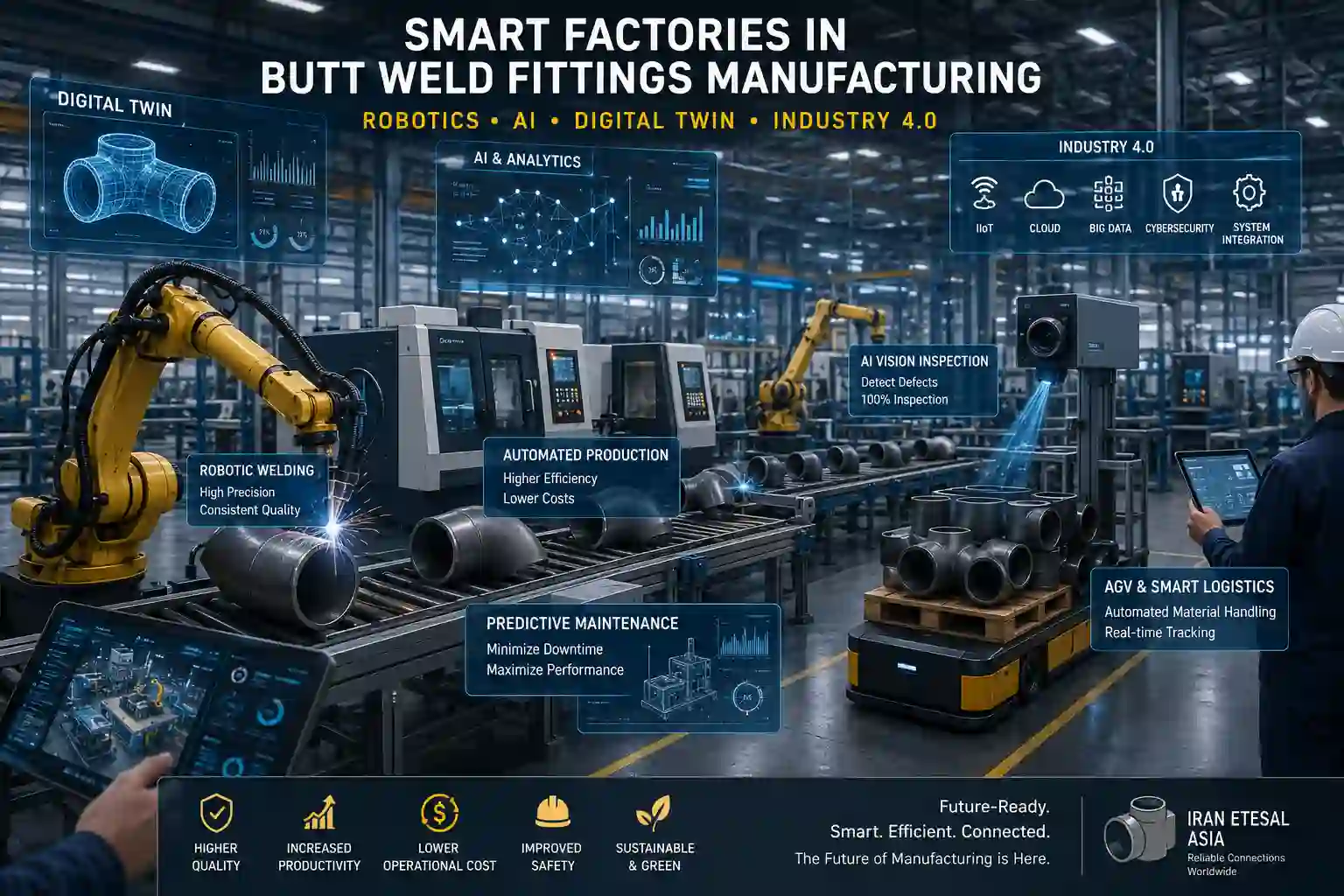
Smart Factories in Butt Weld Fittings Manufacturing:
How Robotics, Artificial Intelligence, Digital Twins and Industry 4.0 Are Transforming the Future of Industrial Pipe Fittings
Introduction
The global manufacturing landscape is undergoing one of the most profound transformations since the Industrial Revolution. This shift—often referred to as the Fourth Industrial Revolution or Industry 4.0—is fundamentally changing how industrial components are designed, produced, and delivered. Among the most critical yet traditionally conservative sectors is the production of butt weld fittings, essential components used in oil and gas, petrochemical, power generation, and water infrastructure.
Butt weld fittings include elbows, tees, reducers, caps and stub ends. These components must withstand extreme pressures, corrosive environments and temperature fluctuations. Historically, their manufacturing relied heavily on manual labor, conventional machining, and isolated production steps. However, the integration of industrial robotics, artificial intelligence, digital twins, and IIoT is reshaping the entire value chain—from raw material handling to final inspection and packaging.
This article provides a comprehensive examination of how smart manufacturing technologies are revolutionizing butt weld fittings production. We explore the core technologies, their practical applications, real-world examples, benefits, challenges, and the strategic implications for manufacturers, engineers, and procurement professionals. The content is designed for industrial decision-makers who need to understand both the technical and business dimensions of this ongoing industrial evolution.
Current Challenges of Traditional Pipe Fittings Manufacturing
Before examining the solutions offered by smart manufacturing, it is essential to understand the limitations of conventional butt weld fittings production. Traditional factories face several structural challenges that affect quality, efficiency, and competitiveness.
- Manual Dependency: Many forming, welding, and finishing operations rely on skilled human operators. This creates variability, increases defect rates, and limits production scalability.
- Quality Inconsistency: Without real-time monitoring, dimensional deviations and welding defects often go undetected until final inspection, leading to rework and scrap.
- Energy Inefficiency: Heat treatment and forming processes consume significant energy. Without optimization, energy waste directly impacts operating costs and environmental footprint.
- Limited Traceability: Paper-based records and siloed databases make it difficult to trace a fitting's complete production history, which is critical for industries with strict regulatory requirements.
- Long Changeover Times: Switching between product types—for example, from 6-inch elbows to 12-inch reducers—requires manual retooling, causing downtime and reducing overall equipment effectiveness (OEE).
These challenges are not merely operational inconveniences. In the context of global steel market dynamics, manufacturers who fail to modernize risk losing market share to competitors who embrace automation and data-driven production.
Evolution from Conventional Factories to Smart Factories
The journey from conventional to smart factories is best understood through the lens of industrial revolutions. Table 1 compares the defining characteristics of Industry 3.0 (automation based on PLCs and computers) with Industry 4.0 (cyber-physical systems and data integration).
| Feature | Industry 3.0 (Conventional Factory) | Industry 4.0 (Smart Factory) |
|---|---|---|
| Automation | Isolated automated cells | Fully integrated, self-optimizing systems |
| Data | Historical, batch-based | Real-time, continuous, streaming |
| Decision Making | Human-driven | AI-assisted, predictive, autonomous |
| Connectivity | Wired, limited protocols | Wireless, 5G, IIoT, cloud/edge |
| Maintenance | Reactive or scheduled | Predictive, condition-based |
| Quality Control | Sampling and offline inspection | 100% in-line, non-destructive, machine vision |
| Traceability | Manual or batch-level | Individual product digital thread |
The smart factory does not simply replace humans with robots; it creates a connected ecosystem where machines, sensors, and software collaborate in real time. For butt weld fittings manufacturers, this means the ability to produce complex geometries with micron-level precision while maintaining full traceability from steel plate to finished fitting.
What is Industry 4.0?
Industry 4.0 is the convergence of digital and physical systems in manufacturing. It is characterized by four core principles:
- Interoperability: Machines, devices, sensors, and people communicate with each other through the Industrial Internet of Things (IIoT).
- Information Transparency: Real-time data from production processes is aggregated and contextualized to create a "digital twin" of the factory.
- Technical Assistance: Systems support humans in decision-making and problem-solving through AI, visualization, and augmented reality.
- Decentralized Decisions: Cyber-physical systems make autonomous decisions and adjust production parameters without human intervention.
For butt weld fittings, these principles translate into practical applications such as robotic welding cells that adjust parameters based on sensor feedback, digital twins that simulate forming processes before physical production, and AI-driven quality inspection that detects micro-cracks invisible to the human eye.
Core Technologies of Industry 4.0
The following sections explore the specific technologies that are enabling the transformation of butt weld fittings manufacturing. Each technology is examined in terms of its industrial application and practical benefits.
Industrial Robotics
Industrial robots have been a cornerstone of manufacturing for decades, but their role in butt weld fittings production has expanded significantly. Modern robotic systems are no longer limited to simple pick-and-place tasks. They are now integrated with advanced sensing, vision systems, and force control to perform complex operations such as:
- Robotic Welding: Automated MIG, TIG, and submerged arc welding (SAW) of butt weld fittings. Robots ensure consistent weld bead geometry, penetration, and heat input, reducing human error.
- Robotic Forming: Hydraulic presses and forming machines equipped with robotic manipulators for precise positioning of elbows and tees during hot forming and cold forming.
- Robotic Grinding and Finishing: Removing weld spatter, smoothing surfaces, and preparing fittings for coating or inspection.
- Robotic Material Handling: Moving heavy steel plates, semifinished fittings, and finished products across the factory floor.
The table below compares the main robot types used in modern pipe fittings factories.
| Robot Type | Typical Application | Payload | Reach |
|---|---|---|---|
| Articulated 6-axis | Welding, grinding, material handling | 6–500 kg | 800–3200 mm |
| Collaborative (Cobot) | Small-part assembly, inspection, machine tending | 3–35 kg | 500–1300 mm |
| SCARA | Precision assembly, packaging | 1–20 kg | 400–1200 mm |
| Delta (Parallel) | High-speed picking, packaging | 1–8 kg | 300–800 mm |
| Mobile (AGV/AMR) | Transporting materials across factory | Up to 2000 kg | N/A |
Collaborative Robots (Cobots)
Unlike traditional industrial robots that operate inside safety cages, collaborative robots—or cobots—are designed to work alongside human operators. For butt weld fittings manufacturers, cobots are particularly valuable in:
- Inspection: Cobots equipped with cameras and lasers can perform in-line dimensional inspection.
- Machine Tending: Cobots load and unload CNC machines, presses, and heat treatment furnaces.
- Small-Batch Welding: For short production runs, cobots offer flexibility and rapid reconfiguration.
Artificial Intelligence in Manufacturing
AI is perhaps the most transformative technology in the smart factory. In butt weld fittings production, AI applications span the entire manufacturing lifecycle.
- Machine Learning for Process Optimization: Algorithms analyze data from sensors to optimize forging temperatures, welding speeds, and cooling rates.
- Computer Vision for Quality Inspection: AI-powered cameras detect surface defects, dimensional deviations, and welding imperfections with accuracy exceeding human inspectors.
- Predictive Quality: Machine learning models predict the probability of defects before they occur, enabling proactive adjustments.
- Demand Forecasting: AI models analyze historical orders, market trends, and economic indicators to optimize production planning.
The adoption of AI is not merely an incremental improvement—it fundamentally changes the relationship between production data and decision-making. For manufacturers who supply critical infrastructure industries, AI-driven quality assurance significantly reduces the risk of field failures.
Industrial Internet of Things (IIoT)
IIoT refers to the network of sensors, actuators, and connected devices that collect and exchange data in industrial environments. In a butt weld fittings factory, IIoT enables:
- Real-Time Monitoring: Sensors measure temperature, pressure, vibration, and energy consumption on every machine.
- Condition Monitoring: Vibration analysis on forming presses and welding equipment detects early signs of wear and prevents unplanned downtime.
- Energy Management: Smart meters and sensors track energy usage per product, enabling granular optimization.
Cloud Computing and Edge Computing
The data generated by IIoT devices must be processed and analyzed. Cloud computing provides scalable storage and advanced analytics, while edge computing enables real-time processing close to the machines. For butt weld fittings manufacturing:
- Cloud: Centralized dashboards, remote monitoring, and long-term data storage for trend analysis.
- Edge: Low-latency control loops for welding robots, where milliseconds matter.
Digital Twin
A digital twin is a virtual replica of a physical asset, process, or system. For butt weld fittings, digital twins are used to simulate production processes, predict outcomes, and optimize operations without interrupting physical production.
The table below summarizes the key benefits of digital twin implementation.
| Application | Benefit |
|---|---|
| Process simulation of elbow forming | Reduces trial-and-error, minimizes scrap |
| Welding simulation | Predicts thermal distortion, optimizes parameters |
| Production scheduling | Optimizes material flow, reduces bottlenecks |
| Maintenance planning | Predicts component life, schedules proactive repairs |
Predictive Maintenance
Predictive maintenance uses data analytics to predict equipment failures before they occur. In a butt weld fittings factory, predictive maintenance applies to critical assets such as:
- Hydraulic presses (forming)
- Induction heating systems (heat treatment)
- Robotic welding cells
- CNC machining centers
By reducing unplanned downtime, predictive maintenance directly improves OEE and reduces maintenance costs.
Automated Quality Inspection
Quality inspection is a critical step in butt weld fittings production. Traditional inspection relies on manual measurements and random sampling. Automated inspection systems—combining machine vision, laser scanners, and AI—enable 100% in-line inspection.
- Dimensional Inspection: Laser-based systems measure wall thickness, diameter, and bend radius with micron precision.
- Surface Inspection: High-resolution cameras detect scratches, pits, and other surface defects.
- Welding Inspection: Automated ultrasonic testing (AUT) and phased array ultrasound provide non-destructive testing (NDT) of welded joints.
Automated Welding Systems
Welding is the most critical step in the production of butt weld fittings. Automated welding systems integrate robotics, sensors, and adaptive control to achieve consistent, high-quality welds.
- Arc Welding Robots: Used for longitudinal and circumferential welds on elbows and tees.
- Laser Welding: Increasingly used for high-precision applications.
- Adaptive Control: Real-time adjustment of welding parameters based on sensor feedback.
Automated Material Handling
Material handling in butt weld fittings factories involves moving steel plates, formed fittings, and finished products. Automation technologies include:
- Automated Guided Vehicles (AGVs): Follow fixed paths using floor magnets or wires.
- Autonomous Mobile Robots (AMRs): Navigate dynamically using sensors and AI, adapting to changing factory layouts.
- Overhead Conveyors and Hoists: Transport heavy components safely and efficiently.
Industrial Sensors
Sensors are the eyes and ears of the smart factory. The table below lists common sensors used in pipe fittings manufacturing.
| Sensor Type | Application |
|---|---|
| Temperature sensors (thermocouples, IR) | Heat treatment monitoring |
| Pressure sensors | Hydraulic press control |
| Vibration sensors | Condition monitoring of rotating equipment |
| Proximity sensors | Position detection for robotic arms |
| Vision cameras | Inspection, part identification |
| Laser scanners | Dimensional measurement |
| Ultrasonic sensors | Thickness measurement, NDT |
MES and ERP Integration
Manufacturing Execution Systems (MES) and Enterprise Resource Planning (ERP) systems form the digital backbone of the smart factory. MES provides real-time visibility into production execution, while ERP manages business processes. Integration between MES and ERP ensures:
- Real-Time Production Tracking: Visibility into order status, work-in-progress, and inventory levels.
- Quality Management: Digital capture of inspection data, non-conformance reports, and corrective actions.
- Traceability: Complete digital thread from raw material to finished fitting.
Big Data Analytics
The smart factory generates massive amounts of data—from sensor readings to quality measurements to production logs. Big data analytics transforms this raw data into actionable insights:
- Root Cause Analysis: Identifying factors that contribute to defects.
- Process Optimization: Finding optimal operating parameters.
- Production Forecasting: Predicting output and resource requirements.
- Supply Chain Optimization: Aligning production with demand.
Benefits of Smart Manufacturing for Butt Weld Fittings
The adoption of smart manufacturing technologies delivers measurable benefits across the entire production chain. The table below compares traditional and smart factory performance across key metrics.
| Metric | Traditional Factory | Smart Factory | Improvement |
|---|---|---|---|
| Overall Equipment Effectiveness (OEE) | 60–70% | 80–90% | +15–25% |
| Defect Rate | 2–5% | 0.1–0.5% | 90% reduction |
| Energy Consumption per Unit | Baseline | 10–20% lower | Significant savings |
| Changeover Time | 60–120 min | 10–20 min | 80% reduction |
| Traceability | Batch-level | Individual product | Complete digital thread |
Beyond operational metrics, smart manufacturing also delivers strategic advantages. Manufacturers can respond faster to market changes, offer higher product quality, and build stronger customer relationships through transparency and digital documentation.
Real Examples from Global Manufacturers
Several leading steel and pipe fittings manufacturers have already implemented smart manufacturing solutions. While specific company names are sometimes proprietary, the industry has documented compelling case studies:
- Robotic Welding Centers: Major Asian manufacturers have deployed robotic welding cells for large-diameter elbows, achieving 100% repeatability and reducing welding defects by over 90%.
- Digital Twin for Heat Treatment: European manufacturers use digital twins to simulate the heat treatment cycle, optimizing temperature profiles and reducing energy consumption by 15%.
- AI-Based Dimensional Inspection: Manufacturers in the Middle East have implemented AI-powered vision systems that measure fitting dimensions in real time, reducing manual inspection labor by 70%.
- Integrated MES and ERP: Large multinational steel pipe manufacturers have deployed fully integrated MES/ERP systems that track every fitting from production order to shipment.
These examples demonstrate that smart manufacturing is not a theoretical concept—it is being implemented successfully in real factories, delivering tangible results.
Explore Iran Etesal Asia International Product Catalog
Iran Etesal Asia provides comprehensive technical information and product specifications for butt weld fittings, elbows, tees, reducers, caps and stub ends. Our multilingual catalog enables engineers and procurement specialists from different countries to access detailed technical data in their preferred language. Visit our International Markets page to explore our full product range, download technical datasheets, and learn more about our commitment to quality and innovation.
How Smart Manufacturing is Changing Butt Weld Fittings Production
The application of smart manufacturing technologies varies across different types of butt weld fittings. This section provides a product-by-product breakdown.
Elbows
Elbow fittings (45° and 90°) are among the most commonly produced butt weld fittings. Smart manufacturing has transformed elbow production in several ways:
- Forming: AI-optimized hot forming processes ensure consistent wall thickness and bend radius.
- Welding: Robotic welding systems with seam tracking produce defect-free longitudinal and circumferential welds.
- Inspection: Automated laser measurement systems verify dimensional accuracy against ASME B16.9 requirements.
For detailed guidance on elbow selection, refer to our 45° vs 90° Elbow Selection Guide.
Tees
Tee fittings (equal and reducing) present complex geometry that challenges traditional manufacturing. Smart technologies help address these challenges:
- Simulation: Digital twins simulate the extrusion and forming process, reducing scrap rates.
- Welding: Branch welding is automated using robots with adaptive parameter control.
- NDT: Automated ultrasonic testing ensures weld integrity.
Reducers
Reducers (concentric and eccentric) require precise forming and dimensional control. Smart manufacturing enhances:
- Forming: Presses equipped with sensors and AI adjust parameters in real time.
- Inspection: Laser-based measurement ensures concentricity and wall thickness uniformity.
- Traceability: Each reducer is tracked through the entire production process.
Caps
Caps are relatively simple fittings, but smart manufacturing still provides value:
- Forming: Automated deep drawing processes with real-time thickness monitoring.
- Inspection: Vision systems detect surface defects and dimensional deviations.
Stub Ends
Stub ends are used with lap joint flanges. Smart manufacturing ensures:
- Precision Machining: CNC machines with automated tool monitoring.
- Quality: Inspection systems verify surface finish and dimensional accuracy.
Smart Manufacturing Across the Production Chain
The impact of Industry 4.0 extends across all stages of butt weld fittings production.
Heat Treatment
Heat treatment cycles (normalizing, quenching, tempering) are critical for achieving the required mechanical properties. Smart sensors and control systems ensure:
- Precise temperature control within ±5°C
- Real-time monitoring of cooling rates
- Digital documentation of heat treatment parameters
Inspection and Testing
Automated inspection systems are now capable of performing 100% in-line inspection, significantly reducing the risk of defective products reaching customers. Key technologies include:
- Ultrasonic Testing (UT): For detecting internal discontinuities.
- Magnetic Particle Inspection (MPI): For surface crack detection.
- Dimensional Measurement: Using laser and vision systems.
Marking and Traceability
Smart factories use laser marking and RFID tags to uniquely identify each fitting. This enables:
- Complete traceability from raw material to finished product.
- Digital documentation of inspection results and test certificates.
- Faster recall and root cause analysis in case of quality issues.
Packaging and Warehousing
Automated packaging lines and warehouse management systems (WMS) ensure efficient logistics. AGVs and AMRs transport finished fittings to storage areas, and automated picking systems prepare orders for shipment.
Future Trends Until 2035
The next decade will bring further technological advances that will reshape butt weld fittings manufacturing. Key trends to watch include:
- AI-Driven Autonomous Operations: Factories that operate with minimal human intervention, with AI making most operational decisions.
- Digital Twin Integration: Complete digital replica of the entire factory, enabling simulation and optimization at the system level.
- 5G Connectivity: Ultra-reliable low-latency communication for real-time control of robotic systems.
- Additive Manufacturing: 3D printing of complex geometries, potentially reducing material waste.
- Sustainable Manufacturing: Integration of renewable energy, closed-loop water systems, and carbon capture technologies.
- Blockchain for Traceability: Secure, immutable records of product provenance and quality data.
Challenges and Barriers
Despite the clear benefits, the adoption of smart manufacturing in butt weld fittings production faces several challenges:
Investment Costs
The initial capital expenditure for robotics, sensors, software, and infrastructure is significant. However, the ROI, as shown in Table 6, can be compelling over a 3–5 year horizon.
| Investment Area | Typical Payback Period |
|---|---|
| Robotic welding cells | 2–3 years |
| Automated inspection systems | 1.5–2.5 years |
| MES/ERP integration | 2–4 years |
| Predictive maintenance systems | 1–2 years |
Cybersecurity
Increased connectivity exposes factories to cyber threats. Manufacturers must invest in robust cybersecurity measures to protect production systems and intellectual property.
Workforce Training
The shift to smart manufacturing requires workers with new skills—data analytics, programming, and system integration. Training and upskilling programs are essential.
Integration Complexity
Integrating new systems with existing legacy equipment can be challenging. A phased approach with clear milestones helps manage complexity.
Environmental Benefits
Smart manufacturing contributes to environmental sustainability in several ways:
- Energy Optimization: AI and IIoT reduce energy consumption by 10–20%.
- Waste Reduction: Defect reduction minimizes scrap and rework.
- Green Steel Production: Integration with low-carbon steelmaking processes.
- Carbon Footprint Tracking: Real-time monitoring of emissions and energy usage.
Impact on Butt Weld Fittings Quality
Quality is the primary value driver for smart manufacturing in pipe fittings. The following are specific areas of improvement:
- Dimensional Accuracy: Automated measurement and adaptive control ensure compliance with ASME B16.9 tolerances.
- Welding Quality: Robotic welding with seam tracking and parameter control eliminates human error.
- Traceability: Complete digital records provide confidence for safety-critical applications.
- Surface Quality: Automated inspection detects defects before they reach customers.
For engineers and procurement professionals, these improvements translate to fewer field failures, lower maintenance costs, and greater reliability.
Understanding the global context is essential for informed procurement. The pipe fittings market analysis provides valuable insights into trends and opportunities. Additionally, the global steel market directly impacts material availability and pricing.
For technical guidance, refer to our elbow manufacturing methods and LR vs SR elbows articles. Material selection often involves choosing between seamless vs welded elbows depending on application requirements.
Quality assurance is critical. Learn how to detect fake pipe fittings and understand common weld joint leak case studies. For long-term reliability, follow our maintenance and repair guide.
For procurement professionals, our procurement guide offers a comprehensive checklist for selecting reliable suppliers and ensuring product quality.
Frequently Asked Questions (FAQ)
1. What is a smart factory?
A smart factory is a highly digitized and connected production facility that uses sensors, robotics, AI, and data analytics to optimize manufacturing processes in real time.
2. How does Industry 4.0 benefit butt weld fittings manufacturing?
Industry 4.0 improves quality, reduces defects, increases productivity, enables complete traceability, and lowers operational costs through data-driven optimization.
3. What role do robots play in pipe fittings production?
Robots perform welding, grinding, material handling, inspection, and machining tasks with high consistency and precision, reducing human error.
4. What is a digital twin in manufacturing?
A digital twin is a virtual replica of a physical asset or process. It enables simulation, analysis, and optimization without interrupting real production.
5. How does AI improve quality control?
AI-powered computer vision systems detect defects and dimensional deviations with accuracy exceeding human inspectors, enabling 100% in-line inspection.
6. What is predictive maintenance?
Predictive maintenance uses sensor data and analytics to predict equipment failures before they occur, reducing unplanned downtime.
7. What are the main challenges of implementing smart manufacturing?
Key challenges include high initial investment, cybersecurity risks, workforce training, and integration complexity with legacy systems.
8. How does smart manufacturing reduce defects?
Real-time monitoring, adaptive control, and automated inspection catch deviations early, reducing scrap and rework.
9. What is the role of MES in a smart factory?
MES provides real-time visibility into production operations, tracks work-in-progress, manages quality data, and enables complete traceability.
10. How does IIoT improve factory efficiency?
IIoT sensors collect real-time data on machine performance, energy usage, and production metrics, enabling data-driven optimization.
11. Can small manufacturers afford smart factory technologies?
Modular solutions, cloud-based software, and collaborative robots make smart manufacturing accessible to small and medium-sized enterprises.
12. How does smart manufacturing support sustainability?
Energy optimization, waste reduction, and real-time carbon tracking contribute to lower environmental impact.
13. What is the future of pipe fittings manufacturing?
The future will see further integration of AI, autonomous systems, and sustainable practices, with factories becoming increasingly self-optimizing.
14. How does traceability benefit end users?
Traceability provides confidence in product quality, enables faster root cause analysis, and simplifies regulatory compliance.
15. Are smart factories safe for workers?
Smart factories improve worker safety by automating hazardous tasks and providing real-time monitoring of dangerous conditions.
Conclusion
The transition from traditional to smart manufacturing represents a fundamental shift in the way butt weld fittings are produced. The integration of robotics, artificial intelligence, digital twins, and IIoT is not merely an incremental improvement—it is a transformation that addresses the core challenges of quality, efficiency, and traceability that have long plagued conventional factories.
While many manufacturers in developing regions are still in the early stages of this transition, the global industry is clearly moving toward intelligent, connected, and highly automated production systems. The economic and competitive advantages of smart manufacturing—including higher quality, lower costs, and greater agility—make it an imperative for forward-looking companies.
Iranian manufacturers also have significant opportunities to adopt modern manufacturing technologies. By leveraging advances in automation, AI, and digitalization, they can enhance product quality, improve operational efficiency, and strengthen their position in both domestic and international markets.
Iran Etesal Asia continuously follows international manufacturing innovations, quality improvement methods, global engineering standards, and modern production technologies. The company is committed to delivering reliable butt weld fittings for domestic and international markets, supported by robust quality management systems and a dedication to continuous improvement.
References
1. International Federation of Robotics (IFR). World Robotics Report. https://ifr.org
2. World Economic Forum. Fourth Industrial Revolution. https://www.weforum.org
3. McKinsey & Company. Industry 4.0: Capturing value at scale in manufacturing. https://www.mckinsey.com
4. Deloitte Insights. Smart Factory 4.0: The future of manufacturing. https://www2.deloitte.com
5. Siemens. Digital Enterprise – Digital Twin. https://www.siemens.com
6. ABB Robotics. Robotics and Automation Solutions for Manufacturing. https://new.abb.com/products/robotics
7. FANUC. Industrial Robots and Automation. https://www.fanuc.com
8. KUKA. Robotics for Industry 4.0. https://www.kuka.com
9. Universal Robots. Collaborative Robotics. https://www.universal-robots.com
10. World Steel Association. Steel Statistical Yearbook. https://worldsteel.org
11. Rockwell Automation. Connected Enterprise. https://www.rockwellautomation.com
12. Schneider Electric. Industrial IoT Solutions. https://www.se.com
13. MIT. AI in Manufacturing. https://www.mit.edu
14. IEEE. Industrial Automation. https://www.ieee.org
15. ScienceDirect. Smart Manufacturing. https://www.sciencedirect.com
16. Springer. Industry 4.0 and Smart Factories. https://www.springer.com
17. MDPI. Applied Sciences – Smart Manufacturing. https://www.mdpi.com