Butt-Weld Elbow Manufacturing Methods | Hot Forming, Cold Forming & Mandrel Process
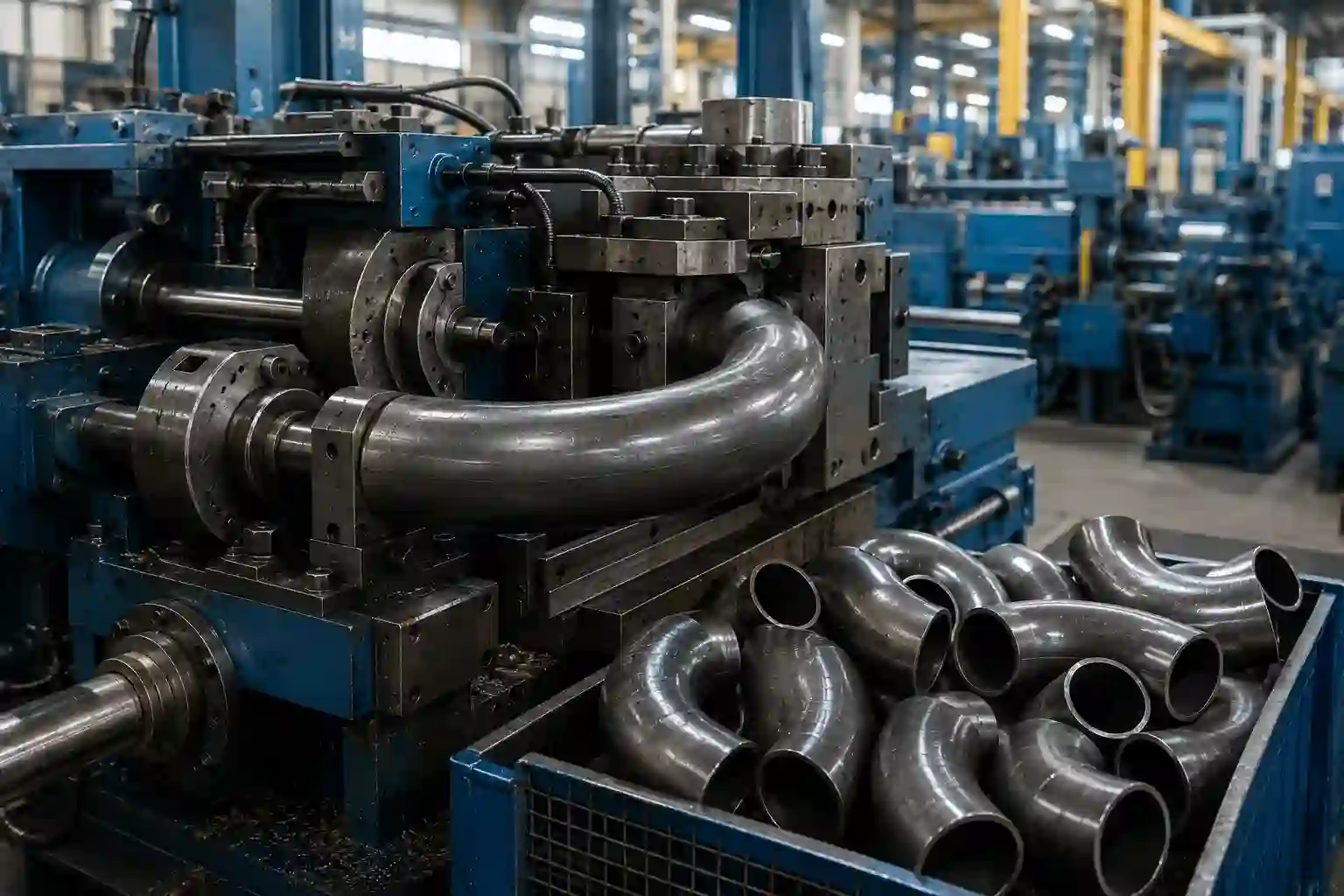
⚙️ Butt-Weld Elbow Manufacturing Methods
Introduction • Hot Forming • Cold Forming • Mandrel Forming • Comparison Table • Standards • Selection Guide • Conclusion
🔍 Introduction
The manufacturing method of a butt-weld elbow has a direct impact on its final quality, mechanical strength, dimensional accuracy, wall thickness uniformity, and service life. Selecting the right production process is one of the most critical decisions in the design and procurement phase of any piping project.
Butt-weld elbows are essential components in oil & gas, petrochemical, power generation, and industrial utility systems, used to redirect fluid flow within pipeline networks. The quality of these fittings can significantly affect pressure drop, weldability, system safety, and maintenance costs.
This comprehensive engineering guide examines the complete range of butt-weld elbow manufacturing methods, including Hot Forming, Cold Forming, and the industry-standard Mandrel Forming process. We compare the advantages, limitations, and applications of each method to help you make the optimal selection for your specific project requirements.
850–1200°C
Press
Controlled
Preparation
🔥 Hot Forming Method
Hot Forming is a manufacturing process in which the elbow is shaped at elevated temperatures, typically between 850°C and 1200°C. The pipe is heated in an industrial furnace until it becomes sufficiently pliable, then formed into the desired elbow shape using mechanical or hydraulic presses. This method is widely employed for large-diameter, heavy-wall elbows and is suitable for a broad range of material grades.
✅ Advantages of Hot Forming
🔹 Reduced Forming Force: Heating the metal lowers its resistance to deformation, requiring less forming pressure.
🔹 High Formability: Enables production of complex geometries and heavy-wall elbows.
🔹 Uniform Wall Thickness: Better thickness distribution in the bend region.
🔹 Suitable for Alloy Materials: Capable of forming alloy steels and stainless steels.
🔸 Limitations of Hot Forming
- High Energy Costs: Requires industrial furnaces and significant energy consumption.
- Surface Oxidation: Oxide layer formation requires post-forming cleaning operations.
- Temperature Control: Precise temperature management is critical to prevent adverse metallurgical changes.
- Extended Production Time: Heating and cooling cycles increase overall manufacturing time.
Precision
Ambient
Dimensional
Preparation
❄️ Cold Forming Method
Cold Forming is a manufacturing process performed at ambient temperature without the application of external heat. The pipe is shaped using mechanical force, typically through cold bending techniques. Due to its lower cost and higher production speed, cold forming is widely adopted for small-diameter, thin-wall elbows in utility and building services applications.
✅ Advantages of Cold Forming
- Lower Cost: No furnace or heating energy required.
- High Production Speed: Faster cycle times suitable for mass production.
- Superior Surface Quality: No oxidation, with excellent dimensional accuracy.
- Work Hardening: Increased material strength due to cold working.
🔸 Limitations of Cold Forming
- Thickness Limitations: Not suitable for heavy-wall or large-diameter pipes.
- Cracking & Wrinkling: Higher risk of surface defects in the bend region.
- Higher Forming Force: Requires greater mechanical force due to room-temperature working.
- Spring Back: The material's tendency to partially return to its original shape requires over-bending and rework.
💡 Engineering Note
Cold Forming is typically specified for small-diameter, thin-wall elbows used in building services, water distribution, and low-pressure utility systems. For industrial applications involving high pressure and elevated temperatures, Hot Forming or Mandrel Forming are generally required.
ASTM A234
Precision
850–1200°C
Tooling
Simultaneous
Dimensional
Stress Relief
Preparation
UT, RT, PMI
🔧 Mandrel Forming – The Industry Standard
Mandrel Forming is the most widely adopted and technically advanced method for producing high-quality butt-weld elbows in the piping industry. In this process, a precision-engineered metal tool called a mandrel is inserted inside the pipe to maintain the internal profile and prevent undesired deformation during forming. The mandrel ensures consistent wall thickness, accurate dimensional tolerances, and superior internal surface finish.
🔹 What is a Mandrel?
A mandrel is a precision metal tool designed with a specific geometry that is placed inside the pipe during the forming process. Its primary function is to support the pipe wall from within, preventing collapse, wrinkling, or thinning at the intrados (inside radius) of the bend. The design of the mandrel directly influences the bend radius, wall thickness distribution, internal surface quality, and dimensional accuracy of the finished elbow.
📌 Importance of Mandrel Design
The design and manufacture of the mandrel is one of the most critical aspects of the elbow production process. A properly designed mandrel ensures wall thickness uniformity, dimensional precision, and superior surface quality in the finished product. Poor mandrel design can result in wall thinning, wrinkling, or dimensional non-conformance.
🔹 Mandrel Forming Process – Step-by-Step
Step 1: Material selection in accordance with project specifications and applicable standards (ASTM A234 WPB, A420 WPL6, A403 WP304/316, etc.).
Step 2: Precision cutting of the raw pipe to the required length.
Step 3: Heating the pipe in a furnace to the specified forming temperature (850–1200°C).
Step 4: Insertion of the mandrel into the pipe to initiate the forming sequence.
Step 5: The pipe is pushed hydraulically over the mandrel and through the forming die.
Step 6: Simultaneous expansion and bending to create the required angle (45°, 90°, or 180°).
Step 7: Dimensional calibration to meet ASME B16.9 tolerance requirements.
Step 8: Post-forming heat treatment to relieve residual stresses and optimize mechanical properties.
Step 9: Beveling and machining to prepare the ends for butt-welding.
Step 10: Comprehensive quality inspection including VT, PT, MT, UT, RT, and PMI testing.
✅ Advantages of Mandrel Forming
🔹 Superior Wall Thickness Uniformity
🔹 Exceptional Dimensional Accuracy
🔹 Excellent Internal & External Surface Quality
🔹 Capable of Large Diameters (up to 48")
🔹 Optimal Mechanical Properties
🔹 Minimized Risk of Wrinkling or Cracking
📊 Manufacturing Methods Comparison Table
| Feature | Hot Forming | Cold Forming | Mandrel Forming |
|---|---|---|---|
| Process Temperature | 850–1200°C | Ambient | 850–1200°C |
| Wall Thickness Uniformity | Good | Moderate | Excellent |
| Dimensional Accuracy | Good | Moderate | Excellent |
| Surface Quality | Requires Cleaning | Excellent | Excellent |
| Production Cost | Medium | Low | Medium-High |
| Production Speed | Medium | High | Medium |
| Large Diameter Capability | Yes | Limited | Yes (up to 48") |
| Cracking / Wrinkling Risk | Low | High | Very Low |
📄 Industry Standards & Specifications
Butt-weld elbow manufacturing must comply with internationally recognized standards. The most important standards include:
- ASME B16.9: Primary standard for dimensions, tolerances, and specifications of butt-weld fittings
- ASME B31.3: Standard for process piping design and construction
- ASTM A234: Material specification for carbon and alloy steel butt-weld fittings
- ASTM A420: Material specification for low-temperature butt-weld fittings
- ASTM A403: Material specification for stainless steel butt-weld fittings
- MSS SP-75: Specification for heavy-wall butt-weld fittings in oil and gas transmission
🎯 Selection Guide – Which Method to Choose?
✅ Choose Mandrel Forming When:
- Oil, gas, and petrochemical projects
- High pressure and temperature service
- Wall thickness uniformity is critical
- Large diameters (up to 48")
- Stringent quality and code requirements
✅ Choose Hot Forming When:
- Medium to large diameters
- Heavy wall thickness
- Alloy material grades
- Moderate budget constraints
✅ Choose Cold Forming When:
- Small diameters
- Thin wall thickness
- Limited budget
- Mass production requirements
- Building services and utility projects
🎯 Final Conclusion
✅ Executive Summary
🔹 Mandrel Forming: The preferred choice for critical industrial applications involving high pressure and elevated temperatures. Delivers superior wall thickness uniformity, exceptional dimensional accuracy, and excellent surface quality.
🔹 Hot Forming: A reliable option for medium to large diameter elbows with heavy wall thickness. Offers good quality at a moderate cost.
🔹 Cold Forming: The most economical solution for small diameter, thin-wall elbows in general utility and building services applications. Provides high production speed and low cost.
📌 Final Note: The selection of the appropriate manufacturing method should be based on project conditions, operating pressure, temperature, fluid characteristics, budget, and applicable codes and standards. Always source from reputable manufacturers such as Iran Etesal Asia Steel Industries to ensure quality and reliability.
🏭 Iran Etesal Asia Steel Industries
Premium Butt-Weld Elbows • Seamless & Welded • LR & SR • ASME B16.9
Contact us for consultation and price inquiries.
🔗 Reference Links
📚 Related Articles
This article was prepared as a purchasing guide for butt-weld fittings.
Published: July 2026 • Last Updated: July 2026 • Source: Iran Etesal Asia Steel Industries