
SCH 40 vs SCH 80 Butt Weld Fittings: Thickness, Weight, Pressure Rating & Applications

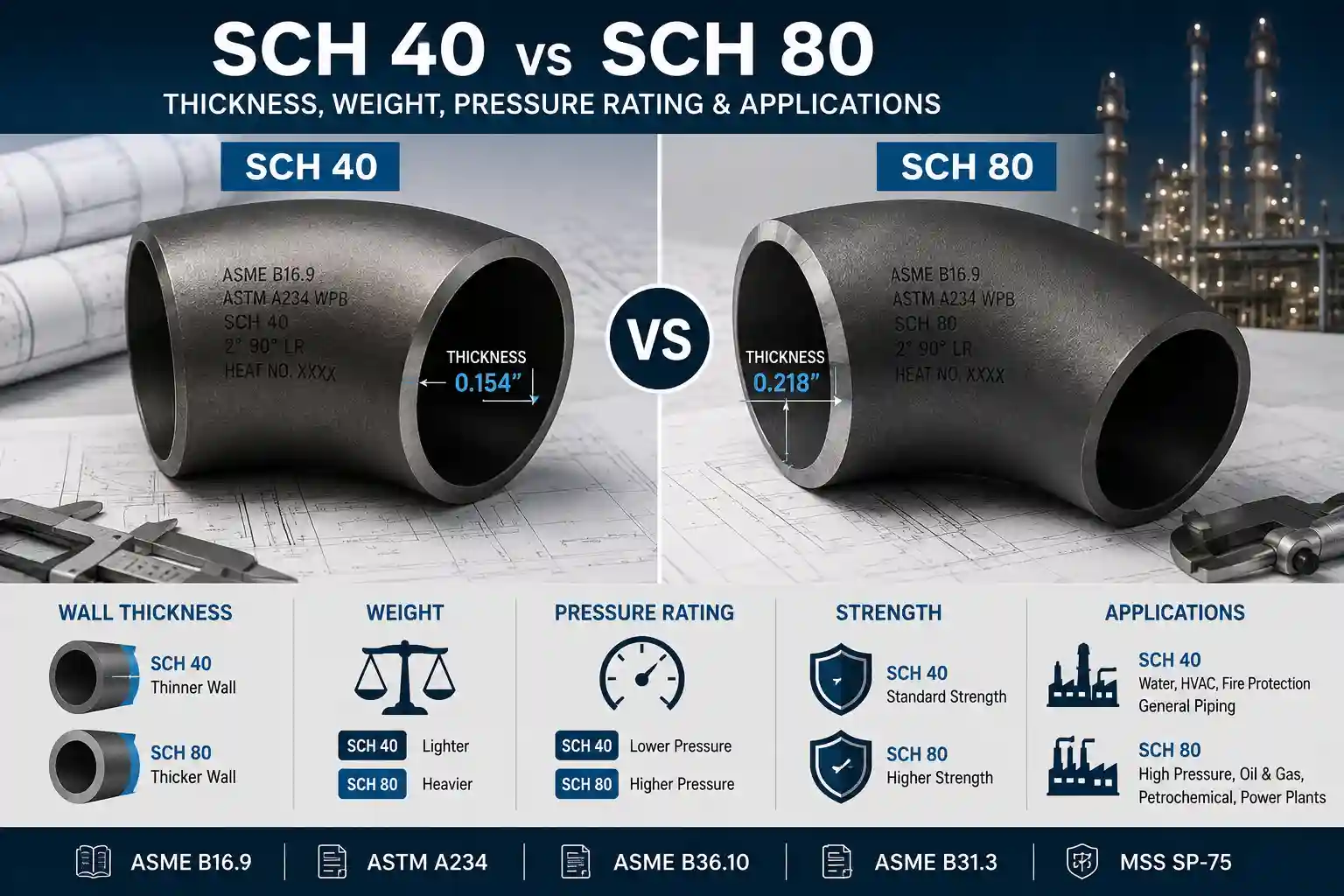
SCH 40 vs SCH 80 Butt Weld Fittings: Thickness, Weight, Pressure Rating, Cost & Engineering Applications
1. Introduction
The selection between Schedule 40 (SCH 40) and Schedule 80 (SCH 80) butt weld fittings is a foundational engineering decision that reverberates across the entire lifecycle of a piping system. It directly impacts pressure containment integrity, flow efficiency, structural support design, welding productivity, procurement cost, and long-term reliability. For engineers, EPC contractors, consultants, QA/QC inspectors, and industrial buyers, a deep, standards-based understanding of these two schedules is not optional—it is imperative for safe, code-compliant, and economically optimized plant design.
This article provides a definitive, technically rigorous reference on SCH 40 and SCH 80 butt weld fittings. Every technical statement is grounded in authoritative standards including ASME B16.9, ASME B36.10M, ASME B36.19M, ASTM A234, ASTM A960, and ASME B31.3. We explicitly do not fabricate dimensions, pressure ratings, or mechanical properties. Where numerical values are not available in public standards, we clearly state the need to consult the applicable source. This approach ensures the content remains a reliable engineering resource, free from the speculation and inaccuracies common in non-technical publications.
2. What is Pipe Schedule?
Pipe Schedule (abbreviated as SCH) is a dimensionless number standardized in ASME B36.10M (for carbon and alloy steel pipes) and ASME B36.19M (for stainless steel pipes). It establishes a fixed wall thickness for a given Nominal Pipe Size (NPS). The origin of the schedule number lies in the formula Schedule = 1000 × (P/S), where P is the internal design pressure and S is the allowable stress of the material at temperature. However, in modern practice, schedule numbers are a standardised series of thicknesses and do not change with material grade.
A critical principle is that for a specific NPS, the outside diameter (OD) remains constant across all schedules. Increasing the schedule number therefore increases wall thickness and consequently decreases the inside diameter (ID). This geometric relationship has profound implications for pressure capacity, flow area, weight, and cost. It is essential to recognize that Schedule is not a pressure class. While thicker schedules generally offer higher pressure resistance, the actual pressure rating depends on material properties, design temperature, corrosion allowance, and the specific design rules of codes like ASME B31.3.
3. Relevant Engineering Standards
Butt weld fittings are manufactured, inspected, and tested to a harmonized suite of standards. These standards define geometry, materials, tolerances, and design basis:
- ASME B16.9 – Factory-Made Wrought Buttwelding Fittings: This is the primary dimensional standard for fittings in NPS ½ through 48. It specifies the dimensions (center-to-end, outside diameter, wall thickness), tolerances, marking, and testing requirements. It references the wall thickness series from ASME B36.10/B36.19, mandating that fittings have a wall thickness at least equal to the corresponding pipe schedule.
- ASME B36.10M – Welded and Seamless Wrought Steel Pipe: This standard provides the comprehensive tables of outside diameter, wall thickness, and weight for carbon and alloy steel pipe for all schedule numbers, including SCH 40, SCH 80, and others.
- ASME B36.19M – Stainless Steel Pipe: The parallel standard for austenitic stainless steel pipe, which has slightly different wall thickness series compared to carbon steel.
- ASTM A234/A234M – Standard Specification for Piping Fittings of Wrought Carbon Steel and Alloy Steel: This material standard covers fittings for moderate and high-temperature service. It specifies chemical composition, tensile properties, heat treatment, and testing.
- ASTM A960/A960M – Standard Specification for Common Requirements for Wrought Steel Piping Fittings: This standard establishes the general requirements for fittings, including heat treatment, certification, marking, and dimensional tolerances, and is often invoked alongside A234.
- ASME B31.3 – Process Piping: The governing design code for process piping systems. It provides the rules for calculating the required wall thickness based on internal pressure, allowable stress, joint efficiency, and corrosion allowance.
- MSS SP-75 – Specification for High-Test Wrought Buttwelding Fittings: Used for high-yield strength fittings in pipeline applications.
These standards are not used in isolation. A typical specification will require fittings to be manufactured per ASME B16.9, of material per ASTM A234 WPB, with wall thickness per ASME B36.10M, and designed per ASME B31.3. The interplay ensures consistency and reliability.
4. What is SCH 40?
Schedule 40 (SCH 40) represents the most commonly selected schedule for general industrial piping. It offers a moderate wall thickness that provides a practical balance between mechanical strength, internal flow area, and cost. For NPS ¼ through NPS 10, SCH 40 wall thickness is identical to the historical Standard (STD) weight designation. A typical example from ASME B36.10M is NPS 6, where SCH 40 wall thickness is 0.280 inches (7.11 mm).
Characteristics
- Moderate wall thickness with a relatively large inside diameter for good flow characteristics.
- Lower weight per unit length compared to heavier schedules, easing handling and support.
- Widely available from manufacturers and distributors, leading to short lead times.
Applications
- Cooling water and raw water systems.
- Fire protection systems (per NFPA 13).
- HVAC chilled water and hot water loops.
- General process piping at moderate pressures (typically below 300 psig depending on material and temperature).
- Compressed air and utility services.
Advantages
- Lower initial material cost.
- Reduced welding time and consumables due to thinner wall.
- Lower transportation and rigging costs.
- Easier field fabrication and modification.
Limitations
- Limited corrosion/erosion allowance – typically not suitable for highly corrosive or erosive services.
- Lower pressure rating at elevated temperatures.
- Reduced structural rigidity compared to heavier schedules.
5. What is SCH 80?
Schedule 80 (SCH 80) provides a significantly thicker wall, approximately 50% to 60% thicker than SCH 40 for most NPS sizes, offering superior strength and durability. For NPS ¼ through NPS 10, SCH 80 is equivalent to the historical Extra Strong (XS) designation. Using the same NPS 6 example, SCH 80 wall thickness per ASME B36.10M is 0.432 inches (10.97 mm).
Characteristics
- Substantial wall thickness that provides a high margin for pressure containment.
- Smaller inside diameter, which reduces flow area and increases fluid velocity.
- Higher weight, impacting structural supports and lifting requirements.
Applications
- Oil and gas gathering, transmission, and processing.
- Refinery process lines, especially where high temperature and pressure are present.
- Petrochemical and chemical plant reactor and transfer lines.
- Power plant high-pressure steam, feedwater, and boiler circulation systems.
- High-pressure gas pipelines and superheated steam services.
Advantages
- Higher internal pressure capacity for a given material and temperature.
- Greater corrosion and erosion allowance, extending service life in aggressive environments.
- Superior mechanical strength, providing better resistance to external loads, bending, and vibration.
- Often specified in safety-critical systems handling toxic or flammable fluids.
Limitations
- Significantly higher material and fabrication cost.
- Heavier weight, increasing transportation, handling, and support costs.
- More demanding welding procedures requiring higher heat input, preheat, and often post-weld heat treatment (PWHT).
- Reduced flow area, which can increase pressure drop and pump energy consumption.
6. SCH 40 vs SCH 80: Detailed Comparison
| Attribute | SCH 40 | SCH 80 |
|---|---|---|
| Wall Thickness (e.g., NPS 6) | 0.280″ (7.11 mm) – ASME B36.10M | 0.432″ (10.97 mm) – ASME B36.10M |
| Weight (e.g., NPS 6 pipe) | Approx. 18.97 lb/ft | Approx. 28.57 lb/ft |
| Inside Diameter (e.g., NPS 6) | Larger (6.065″) | Smaller (5.761″) |
| Pressure Capacity (relative) | Baseline for general service | Higher; typically 40–60% greater for same material |
| Flow Area & Pressure Drop | Greater area, lower ΔP | Smaller area, higher ΔP; pump sizing impact |
| Corrosion/Erosion Allowance | Limited (e.g., 1/16″ typical) | Substantial (e.g., 1/8″ or more) |
| Material Cost | Lower (less steel volume) | Higher (significantly more steel) |
| Fabrication / Machining | Easier, quicker, less tool wear | More difficult, longer machining time |
| Welding Complexity | Lower heat input, easier fit-up | Higher heat input, preheat/PWHT often required |
| Availability | Widely stocked globally | Stocked but less common, especially in large NPS |
| Transportation & Handling | Lighter, lower freight cost | Heavier, requires lifting gear, higher freight |
| Structural Support | Lighter supports, wider spacing | Heavier supports, closer spacing |
| Inspection & NDT | Routine visual, MT/PT | Often requires UT/RT due to thicker sections |
| Lifecycle Cost | Lower initial; may have higher replacement | Higher initial; can offer longer service life |
| Typical Industries | Water/wastewater, fire, HVAC, general industrial | Oil & gas, refining, petrochem, power, chemical |
7. Wall Thickness Explained
The schedule number is the primary driver of wall thickness for a given NPS. Per ASME B36.10M, the wall thickness increases with schedule number. This directly affects the inside diameter (ID = OD – 2 × wall thickness). A thicker wall results in a smaller ID, which reduces the cross-sectional flow area. This has direct consequences for fluid velocity, pressure drop, and pump sizing. Conversely, the increased cross-sectional area of the metal itself improves resistance to internal pressure and external loads. The relationship is linear: for the same NPS, the pressure capacity is roughly proportional to wall thickness, assuming elastic behavior and constant allowable stress.
Importantly, the outside diameter (OD) for a given NPS is fixed regardless of schedule. This is a fundamental principle of the ASME B36.10/19 standards, ensuring that fittings from different schedules can be connected to the same size pipe end. The thicker wall is achieved entirely by reducing the inside diameter.
8. Pressure Design Considerations
The fundamental equation for calculating the required minimum wall thickness for internal pressure in a pipe or fitting is given in ASME B31.3 (Equation 3a):
t = (P × D) / (2 × (S × E + P × Y))
Where:
- t = minimum required wall thickness (inches)
- P = internal design pressure (psig)
- D = outside diameter (inches)
- S = allowable stress at the design temperature (psi) from ASME B31.3 Appendix A
- E = quality factor (joint efficiency) – typically 1.0 for seamless fittings
- Y = coefficient from ASME B31.3 Table 304.1.1, dependent on temperature and material
This equation highlights that the required thickness is a function of pressure, diameter, and allowable stress. For a given NPS and material, increasing the design pressure or decreasing the allowable stress (due to higher temperature) will necessitate a thicker wall. Thus, a system may require SCH 80 even if the base pressure is not exceptionally high if the temperature is elevated. Furthermore, ASME B31.3 mandates the addition of a corrosion allowance (if specified) and mechanical allowances for threading or grooving. The designer must compare the required thickness (plus allowances) to the nominal wall thickness of the chosen schedule. It is a critical engineering error to select a schedule based solely on a generic pressure rating without performing this calculation.
9. Impact on Welding
The thickness difference between SCH 40 and SCH 80 has a substantial impact on welding procedures, productivity, and quality. Thicker fittings demand more rigorous weld preparation, higher heat input, and often preheat and post-weld heat treatment (PWHT). Key considerations include:
- Joint Preparation: While the bevel angle (typically 37.5° ± 2.5° per ASME B16.9) remains the same, the root face and land may differ. The thicker wall of SCH 80 requires a larger weld volume to fill the joint.
- Heat Input: Welding SCH 80 requires significantly higher heat input (kJ/in) to achieve proper fusion and penetration. This can lead to larger heat-affected zones (HAZ) and increased residual stress.
- Preheat and Interpass Temperature: For carbon steels like ASTM A234 WPB, preheat is often mandatory for SCH 80 to prevent hydrogen-induced cracking, especially in thicker sections (typically > 0.75″). Interpass temperature control is also critical.
- Post-Weld Heat Treatment (PWHT): Depending on the material and service, SCH 80 may require PWHT to relieve residual stresses and temper hard microstructures. This adds cost and time to the fabrication schedule.
- Welding Procedure Qualification: Per ASME Section IX, a welding procedure specification (WPS) and procedure qualification record (PQR) must be qualified for the thickness range being welded. A procedure qualified on SCH 40 may not be valid for SCH 80 due to the substantial thickness difference.
- Inspection: Radiographic testing (RT) of thicker welds may require higher-energy sources or longer exposure times. Ultrasonic testing (UT) becomes more reliable due to the thicker section but requires calibrated equipment.
10. Weight Comparison
The weight difference between SCH 40 and SCH 80 fittings is substantial and has cascading effects on logistics and structural design. Using ASME B36.10M data for NPS 6 carbon steel pipe, SCH 40 weighs 18.97 lb/ft, while SCH 80 weighs 28.57 lb/ft – an increase of approximately 50%. For larger NPS, the percentage difference can be even greater.
Handling & Transportation: Heavier fittings require more robust lifting equipment, larger capacity forklifts, and careful rigging. Shipping costs increase due to weight-based freight rates. A single truckload of SCH 80 fittings will contain significantly fewer pieces than an equivalent load of SCH 40.
Structural Support: Pipe supports must be designed for the additional dead weight of SCH 80. This often means closer support spacing, heavier support structures, and more costly foundations. For elevated pipe racks, the cumulative weight increase can be substantial.
11. Cost Comparison
The total installed cost of SCH 80 is significantly higher than SCH 40 due to multiple factors:
- Raw Material: SCH 80 contains considerably more steel by volume. For a typical fitting, the material cost is 60–80% higher.
- Manufacturing: Forming and machining thicker fittings takes more time, requires more powerful equipment, and results in higher tool wear.
- Welding & Fabrication: The higher heat input, additional weld passes, and mandatory preheat/PWHT increase labor costs by 30–50%.
- Transportation: Heavier weight leads to higher freight costs, especially for international or remote project sites.
- Inventory & Stock: SCH 80 fittings are less common than SCH 40 in some sizes, leading to higher stocking costs and longer lead times.
While the initial cost is higher, SCH 80 may offer a lower lifecycle cost in severe services where its increased corrosion allowance and mechanical robustness extend the operational life and reduce maintenance outages.
12. Typical Applications
SCH 40 – Dominant Applications
- Water/Wastewater: Raw water intake, cooling water return, clarified water, and sewage systems where pressure is low to moderate.
- Fire Protection: Sprinkler system mains and branch lines per NFPA 13, where pressure is typically 175–250 psig.
- HVAC: Chilled water (≤ 150 psig) and condenser water circuits.
- General Process: Utility air, nitrogen, natural gas at low pressure, and non-hazardous fluid transfer.
SCH 80 – Critical & Severe Service
- Oil & Gas Upstream: Wellhead flowlines, manifolds, and separation systems with high pressure and potential for sand erosion.
- Refineries: Crude unit transfer lines, hydrotreater effluent, and catalytic cracking unit piping where temperatures exceed 500°F.
- Petrochemical: Reactor effluent, high-pressure ethylene and propylene transfer, and mixed feed lines.
- Power Generation: Main steam, hot reheat, cold reheat, and boiler feedwater systems.
- Chemical Plants: Handling of corrosive acids, caustics, and high-temperature process streams.
13. When SCH 40 is the Better Choice
SCH 40 is the preferred engineering choice in the following scenarios:
- Design pressure is low enough that the calculated required thickness (per B31.3) is less than the SCH 40 wall thickness.
- Corrosion allowance is minimal (≤ 1/16″) and the service is non-erosive.
- Weight and support cost are critical concerns, especially in long pipe runs.
- Field welding productivity is a priority, and the schedule demands rapid fabrication.
- The operating temperature is moderate, and the allowable stress is not severely derated.
- System modifications or tie-ins are anticipated; SCH 40 is easier to cut and weld.
14. When SCH 80 is Necessary
SCH 80 becomes a necessity under these conditions:
- The calculated required wall thickness per ASME B31.3 (including corrosion and mechanical allowances) exceeds the SCH 40 nominal wall.
- A corrosion allowance of 1/8″ or greater is mandated by the process or project specification.
- Erosive fluid velocities (e.g., two-phase flow with solids) require additional wall for wear resistance.
- The system operates at high temperature, causing significant derating of allowable stress.
- ASME B31.3 or the owner's specification requires a minimum wall thickness for toxic, flammable, or lethal service.
- For small NPS (e.g., ¾″ and below), SCH 80 is often specified for mechanical strength even at moderate pressures.
15. STD vs SCH 40
The historical weight designations Standard (STD), Extra Strong (XS), and Double Extra Strong (XXS) predate the schedule number system. When the schedule system was introduced, the wall thickness of STD was mapped to SCH 40 for NPS ¼ through NPS 10. For NPS 12 and larger, however, STD is thinner than SCH 40. In fact, for NPS 12, STD corresponds to a wall thickness of 0.375″ (9.52 mm), while SCH 40 is 0.406″ (10.31 mm) per ASME B36.10M. For NPS 14 and above, the gap widens. Therefore, while STD and SCH 40 are often used interchangeably in small sizes, they are not equivalent for large diameter pipe. Modern engineering specifications increasingly use schedule numbers exclusively to avoid this ambiguity.
16. XS vs SCH 80
Similarly, Extra Strong (XS) has the same wall thickness as SCH 80 for NPS ¼ through NPS 10. For NPS 12 and above, XS is thinner than SCH 80. For example, NPS 12 XS has a wall thickness of 0.500″ (12.70 mm), while SCH 80 is 0.562″ (14.27 mm). The divergence becomes more pronounced at larger sizes. As with STD vs SCH 40, specifying by schedule number (e.g., SCH 80) is the more precise and recommended approach in modern piping design.
17. Common Engineering Mistakes
- Selecting Schedule by Pressure Alone: Pressure is only one variable. Temperature, corrosion, erosion, and external mechanical loads are equally critical.
- Ignoring Corrosion Allowance: A system might start with sufficient wall thickness, but after years of corrosion, the remaining wall may be inadequate. A proper allowance must be added to the required thickness.
- Ignoring Design Temperature: Allowable stress (S) decreases with increasing temperature. A pipe that is adequate at 100°F may fail at 500°F if the schedule is not increased.
- Assuming STD = SCH 40 for All Sizes: As discussed, this is false for NPS ≥ 12, potentially leading to under-designed piping.
- Using Generic Pressure Ratings: Pressure-temperature ratings from non-code sources are often inaccurate. Always calculate per ASME B31.3 or use the component's specific rating per the applicable standard.
- Overlooking Erosion Velocity: In multiphase or solids-laden services, a thicker wall (SCH 80) is often required to provide a wear allowance, regardless of pressure.
- Failing to Account for Branch Connections: Reinforcement for branch connections may require additional thickness at the junction, potentially necessitating a heavier schedule.
18. Inspection and Quality Control
Per ASME B16.9 and ASTM A960, fittings must undergo rigorous inspection and quality control. Key elements include:
- Material Certification (MTR): The manufacturer must provide a mill test report (MTR) certifying the chemical composition and mechanical properties per the applicable ASTM standard (e.g., A234 WPB).
- Heat Number Traceability: Each fitting must be marked with a heat number that ties it to the MTR, ensuring full traceability.
- Permanent Marking: Per ASME B16.9, fittings must be marked with the manufacturer's name, material grade, schedule (or wall thickness), NPS, and heat number. Markings must be legible and durable.
- Visual Inspection: All fittings undergo 100% visual inspection for surface defects (cracks, laps, scale, and pits), end preparation (bevel angle, root face), and overall workmanship.
- Dimensional Inspection: Critical dimensions (outside diameter, wall thickness, center-to-end dimensions for elbows/tees) are checked against the tolerances specified in ASME B16.9, Table 4 and Table 5.
- Non-Destructive Testing (NDT): Depending on the service and specification, NDT methods are applied. Magnetic particle (MT) or liquid penetrant (PT) examination is common for surface defects. Ultrasonic testing (UT) or radiographic testing (RT) may be specified for volumetric examination of internal defects. The extent of NDT is often governed by the ASME B31.3 code or the owner's specifications.
20. Conclusion
The selection of SCH 40 versus SCH 80 butt weld fittings is a nuanced engineering decision that demands careful analysis of pressure, temperature, corrosion, erosion, mechanical loads, and economic factors. SCH 40 offers a cost-effective and readily available solution for a wide range of general services, while SCH 80 provides enhanced strength, durability, and corrosion allowance for severe and critical applications. This decision must be guided by the design rules of ASME B31.3, using the correct material data from ASME B36.10/19 and ASTM standards. By basing the choice on rigorous calculation and sound engineering judgment, rather than rule-of-thumb, one ensures safety, reliability, and optimal lifecycle cost. For project-specific support, consulting with a qualified fitting manufacturer like Iran Etesal and referencing the latest official standards is always advisable.
Need SCH 40 or SCH 80 fittings?
Iran Etesal — ASME B16.9 certified, carbon & stainless, global export.
References
- ASME B16.9-2022 – Factory-Made Wrought Buttwelding Fittings. American Society of Mechanical Engineers. www.asme.org
- ASME B36.10M-2022 – Welded and Seamless Wrought Steel Pipe. ASME. www.asme.org
- ASME B36.19M-2018 – Stainless Steel Pipe. ASME. www.asme.org
- ASTM A234/A234M-22 – Standard Specification for Piping Fittings of Wrought Carbon Steel and Alloy Steel. ASTM International. www.astm.org
- ASTM A960/A960M-22 – Standard Specification for Common Requirements for Wrought Steel Piping Fittings. ASTM. www.astm.org
- ASME B31.3-2022 – Process Piping. ASME. www.asme.org
- MSS SP-75-2022 – Specification for High-Test Wrought Buttwelding Fittings. Manufacturers Standardization Society. www.mss-hq.org
- API 5L-2023 – Specification for Line Pipe. American Petroleum Institute. www.api.org
All dimensional and weight data referenced are from ASME B36.10M for NPS 6 (carbon steel). For exact values, consult the latest standards.
19. Frequently Asked Questions — SCH 40 vs SCH 80 Butt Weld Fittings
Schedule (SCH) is a dimensionless number that defines the wall thickness of pipe or fittings for a given Nominal Pipe Size (NPS). It is standardized in ASME B36.10M (carbon/alloy) and B36.19M (stainless). Higher schedule numbers mean thicker walls, smaller inside diameter, and greater pressure capacity.
ASME B36.10M / B36.19MYes. For any given NPS, SCH 80 has a greater wall thickness than SCH 40. The outside diameter remains constant; the thickness increase comes from reducing the inside diameter.
Direct welding of mismatched schedules is not recommended because the wall thickness difference creates stress concentrations and fit-up difficulties. If unavoidable, a transition piece or appropriate bevel preparation is required, and the welding procedure must be qualified for the thickness transition.
ASME B31.3, ASME Section IXFor NPS ¼ through NPS 10, the wall thickness of Standard (STD) is identical to SCH 40. For NPS 12 and larger, STD is thinner than SCH 40. Always verify the actual wall thickness per ASME B36.10M.
ASME B36.10MFor NPS ¼ through NPS 10, Extra Strong (XS) equals SCH 80. For NPS 12 and above, XS has a thinner wall than SCH 80. Consult ASME B36.10M for exact values.
ASME B36.10MAt elevated temperatures, the allowable stress (S) of the material decreases per ASME B31.3. This increases the required wall thickness for the same pressure. A system that works with SCH 40 at 100°F may require SCH 80 at 500°F.
ASME B31.3, Appendix ASCH 40 provides a limited corrosion allowance, often assumed as 1/16″ (1.6 mm) in many designs. For higher allowances (e.g., 1/8″ or more), SCH 80 or heavier schedules are typically required.
Yes. For the same material, NPS, and temperature, SCH 80 has a higher internal pressure capacity because the hoop stress is distributed over a larger wall thickness. The exact rating must be calculated per ASME B31.3.
ASME B31.3SCH 40 is easier to weld due to lower heat input requirements, simpler preheat control, and less residual stress. SCH 80 often demands preheat, controlled interpass temperature, and sometimes post-weld heat treatment (PWHT).
Yes. The material cost of SCH 80 is typically 60–80% higher due to the greater steel volume. Fabrication, welding, and transportation costs are also higher, often making the total installed cost 40–60% more than SCH 40.
Only for low-pressure, low-temperature steam (e.g., 15 psig heating steam). For high-pressure or high-temperature steam, SCH 80 or heavier is typically required due to the reduced allowable stress and potential for erosion.
ASME B31.1 / B31.3ASME B16.9 covers wrought fittings in carbon steel (ASTM A234), stainless steel (ASTM A403), and alloy steel (ASTM A234), among others. The material must be selected based on the service conditions.
ASME B16.9, ASTM A234, A403Check the mill test report (MTR) for the nominal wall thickness. Physically, use an ultrasonic thickness gauge. Compare the measured value to the required thickness per the schedule and the applicable standard (ASME B36.10/19).
Yes, ASME B16.9 covers fittings in SCH 40 and SCH 80 from NPS ½ through NPS 48. Availability from stock may vary, but the standard covers the entire range.
ASME B16.9The bevel prepares the fitting for butt welding. Per ASME B16.9, the bevel angle and root face are specified to ensure proper fusion and penetration. The typical bevel angle is 37.5° ± 2.5°.
ASME B16.9NDT is often required for SCH 80, especially in high-pressure, high-temperature, or lethal service. Common methods include magnetic particle (MT), liquid penetrant (PT), ultrasonic (UT), and radiographic (RT) testing, as specified by the design code or owner.
ASME B31.3, ASME Section VYes, but it is not typical. SCH 40 is the standard for most fire protection systems (per NFPA 13). SCH 80 may be used in seismic zones, high-rise buildings, or where additional mechanical strength is required.
The smaller inside diameter of SCH 80 reduces the cross-sectional flow area, increasing fluid velocity and pressure drop for a given flow rate. This may require larger pumps or higher system pressure to maintain the same flow.
ASME B36.10M covers carbon and alloy steel pipe wall thicknesses. ASME B36.19M covers stainless steel pipe, which has slightly different wall thickness series due to different material properties and manufacturing processes.
The definitive source is the ASME B16.9 standard for fitting dimensions and ASME B36.10/19 for pipe wall thickness. Always refer to the latest edition of these standards for official, legally binding dimensions.
ASME B16.9, B36.10M, B36.19MYes. SCH 100, SCH 120, SCH 140, and SCH 160 provide even thicker walls for extremely high pressures and severe services. SCH 160 is commonly used in high-pressure gas and steam systems.
ASME B36.10MNot always, but often. PWHT is required per ASME B31.3 for certain material groups and thicknesses. For carbon steels, PWHT is typically required when the nominal wall thickness exceeds 0.75″ (19 mm) or as specified by the engineering design.
ASME B31.3, Table 331.1.1