
Steel Butt Weld Fittings Manufacturing Methods: Technical Analysis of Mechanical Properties, Microstructure, and In-Service Performance
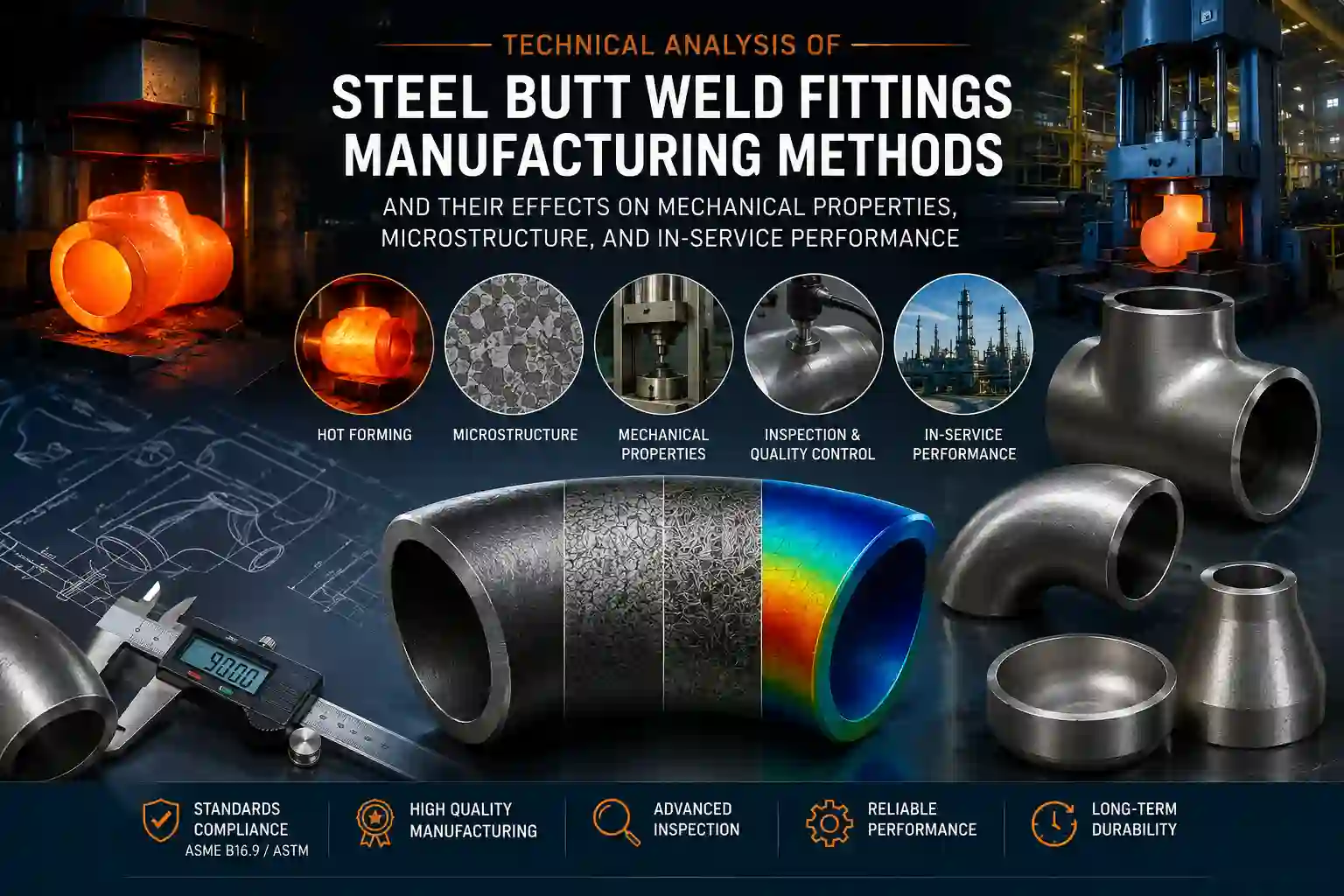
Technical Analysis of Steel Butt Weld Fittings Manufacturing Methods
Comprehensive engineering analysis of manufacturing processes for carbon steel and low-alloy butt weld fittings — examining process mechanics, microstructure evolution, mechanical properties, and in-service performance
Table of Contents
1. Introduction
1.1 Importance of Manufacturing Quality in Butt Weld Fittings
The manufacturing quality of steel butt weld fittings directly determines the integrity, safety, and operational life of the piping systems in which they are installed. Unlike straight pipe sections, butt weld fittings introduce geometric discontinuities—changes in direction, branches, or diameter transitions—that create localized stress concentrations and complex load paths. The manufacturing process must therefore produce components that not only meet dimensional requirements but also possess the microstructural characteristics necessary to withstand these demanding service conditions.
A butt weld fitting is defined as a wrought steel component joined to the pipeline by a full-penetration circumferential butt weld, producing a continuous, leak-free joint with strength equal to the pipe itself. The connection method ensures that the fitting becomes integral to the pressure boundary, making its manufacturing quality critical to system reliability.
Key Principle: The manufacturing method selected for a butt weld fitting must be compatible with the material grade, fitting geometry, size range, and intended service conditions. No single manufacturing process is universally optimal—each presents distinct trade-offs between cost, quality, dimensional accuracy, and mechanical property attainment.
1.2 Why Manufacturing Method Determines Service Life
The service life of a butt weld fitting is fundamentally determined by its manufacturing history. The method by which a fitting is formed—whether through hot forming, cold forming, forging, or induction forming—controls several critical parameters that define its ultimate performance characteristics.
These parameters include grain flow orientation, which influences the material's resistance to crack propagation and its mechanical properties in different directions. The temperature history during forming and subsequent heat treatment determines grain size, phase distribution, and the presence of any detrimental microstructural constituents. The degree of plastic deformation affects work hardening, residual stress, and the material's subsequent response to welding and service loading.
In accordance with ASME B31.3 Section 302.3, the design pressure-temperature rating of piping components is based on the material properties established through standardized testing. These properties must be achieved through proper manufacturing and heat treatment, as specified by the applicable material standard such as ASTM A234.
1.3 Industries Using Butt Weld Fittings
Butt weld fittings are employed across a diverse range of industries where permanent, leak-resistant, high-integrity piping connections are required. Major industries include:
- Oil and Gas (Upstream): Wellhead facilities, flow lines, and production manifolds
- Oil and Gas (Midstream): Transmission pipelines, compressor stations, and metering facilities
- Refining and Petrochemical: Process units, reactors, furnaces, and heat exchanger systems
- Power Generation: Boiler systems, steam lines, cooling water circuits, and supercritical applications
- Water Treatment: High-pressure pumping stations, desalination plants, and distribution systems
- Subsea and Offshore: Risers, subsea manifolds, and topside piping
- Chemical Processing: Corrosive and high-temperature process piping
Each industry places specific demands on fitting performance, requiring careful consideration of material grade, manufacturing method, and quality assurance throughout the production process.
2. Manufacturing Standards
The manufacture of steel butt weld fittings is governed by a comprehensive framework of industry standards that specify dimensional requirements, material properties, testing procedures, and quality assurance criteria. The following standards are most relevant to the manufacturing process.
2.1 ASME B16.9
ASME B16.9 is the primary standard governing factory-made wrought steel butt welding fittings. This standard establishes dimensional requirements, tolerances, marking, and testing for fittings in sizes NPS ½ through NPS 48. It specifies the end-to-end dimensions, wall thickness requirements, and permissible dimensional deviations for all fitting types, including elbows, tees, reducers, and caps. The standard also addresses the requirements for welding end preparation and surface finish quality.
2.2 ASTM Standards
ASTM A234 is the key material specification for carbon and low-alloy steel fittings for moderate and high-temperature service. It defines the chemical composition limits, mechanical property requirements, and heat treatment procedures for grades including WPB, WPC, WP11, and WP22. The standard requires that fittings be manufactured from wrought steel and undergo specified heat treatments to achieve the required microstructure and properties.
ASTM A420 covers low-temperature carbon steel fittings for service down to -46°C (-50°F) and -73°C (-100°F) for Grade WPL6 and WPL9 respectively. This standard includes Charpy V-notch impact testing requirements at specified temperatures to ensure adequate toughness for cryogenic and low-temperature applications.
ASTM A815 applies to duplex and super duplex stainless steel fittings, including UNS S31803, S32205 (2205), S32750, and S32760. The standard requires specific heat treatment procedures to prevent the formation of harmful intermetallic phases and ensure the required corrosion resistance and mechanical properties.
ASTM A403 covers austenitic stainless steel fittings, including grades WP304, WP316, WP321, and WP347. This standard includes requirements for solution annealing heat treatment to ensure corrosion resistance and mechanical properties.
2.3 MSS Standards
MSS SP-75 is the specification for high-test wrought butt-welding fittings for high-pressure transmission pipeline applications. This standard covers fittings manufactured from API 5L line pipe material, providing enhanced mechanical properties for cross-country pipeline applications.
3. Raw Materials
The properties of the finished butt weld fitting are fundamentally dependent on the quality and characteristics of the raw material. The selection and verification of appropriate raw materials are essential to ensure compliance with applicable standards and fitness for service.
3.1 Carbon Steel
According to ASTM A234, the most common carbon steel grades for butt weld fittings are:
- Grade WPB: The most widely used carbon steel grade for moderate and high-temperature service up to approximately 425°C (800°F).
- Grade WPC: Higher carbon and manganese content than WPB, providing increased strength for more demanding service conditions.
- Grade WPL6: Low-temperature carbon steel for service down to -46°C (-50°F).
- Grade WPL9: Low-temperature carbon steel for service down to -73°C (-100°F).
3.2 Low-Temperature Carbon Steel
Low-temperature carbon steel grades per ASTM A420 are designed to maintain adequate impact toughness at sub-zero temperatures. The manufacturing process must ensure that the final fitting achieves the required Charpy impact energy values at the specified test temperature without the presence of hard microstructures that could promote brittle fracture.
3.3 High-Yield Steel
High-yield steel fittings are produced in accordance with MSS SP-75 or API 5L, providing enhanced strength for high-pressure transmission pipeline applications. These fittings are typically manufactured from API 5L Grade X42 through X80 material and are used in cross-country pipelines.
3.4 Alloy Steel
Low-alloy steels per ASTM A234 grades WP11 (1.25% Cr - 0.5% Mo) and WP22 (2.25% Cr - 1.0% Mo) provide enhanced creep resistance and oxidation resistance at elevated temperatures up to 590°C (1100°F).
3.5 Stainless Steel
Austenitic stainless steel fittings per ASTM A403, including WP304 and WP316, offer excellent corrosion resistance for applications in aggressive chemical and marine environments. The manufacturing process must ensure that the solution annealing heat treatment is performed to prevent sensitization and maintain corrosion resistance.
3.6 Duplex and Super Duplex
Duplex stainless steel fittings per ASTM A815 combine the strength of ferritic steels with the corrosion resistance of austenitic steels. These grades require careful control of the manufacturing temperature and cooling rate to prevent the formation of harmful intermetallic phases.
3.7 Nickel Alloys
Nickel alloy fittings per ASTM B366 include Inconel, Monel, and Hastelloy grades, providing superior corrosion resistance and high-temperature strength for the most demanding service conditions.
4. Manufacturing Methods
4.1 Hot Forming
Hot forming is the most common manufacturing method for carbon and low-alloy steel butt weld fittings. In this process, the raw material (pipe or plate) is heated to a temperature above the recrystallization temperature of the steel and formed to the desired shape using dies, punches, or mandrels.
Process Steps:
- Heating: The raw material is heated in a furnace to the target forming temperature (typically 900°C to 1100°C for carbon steel).
- Forming: The heated material is placed in a forming press and shaped using a combination of dies, punches, and mandrels.
- Trimming: Excess material (flash) is removed from the formed fitting.
- Normalizing: The formed fitting is subjected to a normalizing heat treatment to refine the grain structure.
- Machining: The fitting ends are machined to achieve the specified bevel dimensions.
Equipment: Hot forming presses (mechanical or hydraulic), induction or gas furnaces, trimming presses.
Temperature Range: 900°C – 1100°C for carbon steel.
Advantages: Suitable for a wide range of fitting types and sizes, good grain flow alignment, cost-effective for medium to large production runs.
Limitations: Dimensional tolerances are less precise than cold forming, potential for surface scaling.
4.2 Cold Forming
Cold forming is performed at ambient temperature, relying on work hardening to increase the strength of the material. This method is commonly used for fittings manufactured from ductile materials.
Process Steps:
- Forming: The material is formed at ambient temperature using hydraulic presses and dies.
- Stress Relief: The cold-formed fitting is subjected to a stress-relief heat treatment (typically 550°C – 650°C).
- Machining: Fitting ends are machined to final dimensions.
Advantages: Excellent dimensional accuracy, good surface finish, no surface scaling.
Limitations: Limited to ductile materials, work hardening reduces ductility.
4.3 Mandrel Forming
Mandrel forming is a specialized process used to produce elbows with precise wall thickness and dimensional control. A mandrel is inserted into the pipe to prevent wrinkling and maintain the internal diameter during bending.
Advantages: Excellent wall thickness control, smooth internal surface, good dimensional accuracy.
Limitations: Limited to elbows, mandrel design and maintenance costs are significant.
4.4 Induction Forming
Induction forming uses localized induction heating to soften the material only in the region being formed. This process is particularly well-suited for producing large-diameter fittings with precise dimensional control.
Advantages: Precise dimensional control, localized heating minimizes grain growth.
Limitations: High capital costs, specialized equipment.
4.5 Forging
Forging shapes the fitting by compressive forces applied through dies or hammers. Forged fittings exhibit superior mechanical properties due to the refined grain structure and optimized grain flow achieved through controlled deformation.
Advantages: Excellent mechanical properties, refined grain structure, superior impact toughness.
Limitations: Higher material waste, expensive tooling, limited to smaller fitting sizes.
4.6 Press Forming
Press forming uses hydraulic or mechanical presses to form the fitting shape from heated or cold material. This method is commonly used for large-diameter fittings and reducers.
4.7 Extrusion
Hot extrusion forces a heated billet through a die to create the desired cross-sectional shape. This method is particularly well-suited for producing complex fitting geometries with consistent wall thickness.
4.8 Welded Manufacturing
Welded fittings are manufactured from welded pipe or plate with one or more longitudinal or spiral welded seams. This method is typically more economical for large-diameter fittings.
5. Microstructure Evolution
The microstructure of a butt weld fitting evolves throughout the manufacturing process. The final microstructure determines the mechanical properties and service performance of the fitting.
5.1 Grain Growth and Recrystallization
During hot forming, the material undergoes recrystallization, which replaces the deformed grain structure with new, strain-free grains. The grain size is determined by the forming temperature and subsequent cooling rate. Fine grain size (ASTM Grain Size Number 6 to 8) provides improved strength and toughness.
5.2 Phase Transformation
The cooling rate after heat treatment determines the phase transformation. Slow cooling produces ferrite and pearlite, which provide good ductility and toughness. Rapid cooling can produce bainite or martensite, which provide higher strength but reduced ductility.
5.3 Heat-Affected Zones
The heat-affected zone (HAZ) is the region adjacent to the welding end where the microstructure has been altered by the heat of welding. The HAZ may contain coarse grains and hard microstructures that affect weldability.
5.4 Residual Stress
Residual stresses develop during forming and heat treatment due to differential expansion and contraction, plastic deformation, and phase transformations. Stress-relief heat treatment is essential to minimize residual stresses.
6. Heat Treatment
6.1 Normalizing
Normalizing involves heating the fitting to a temperature above the upper critical temperature (typically 870°C – 930°C for carbon steel) and cooling in still air. This process refines the grain structure, relieves residual stresses, and improves mechanical properties.
6.2 Quenching and Tempering
Quenching involves rapid cooling from the austenitizing temperature to form martensite, followed by tempering to achieve the desired combination of strength and toughness.
6.3 Stress Relieving
Stress relieving involves heating to a temperature below the lower critical temperature (typically 550°C – 650°C) to relieve residual stresses without altering the final microstructure.
6.4 Effects on Mechanical Properties
- Strength: Increased by quenching and tempering, decreased by annealing
- Ductility: Increased by annealing and normalizing
- Toughness: Optimized by normalizing and tempering
- Corrosion Resistance: Maintained by proper solution annealing for stainless steels
7. Mechanical Properties
The mechanical properties of butt weld fittings are determined by the material composition, manufacturing method, and heat treatment.
- Yield Strength: Minimum 240 MPa (35,000 psi) for ASTM A234 WPB. Influenced by grain size and dislocation density.
- Ultimate Tensile Strength: 415 – 585 MPa (60,000 – 85,000 psi) for ASTM A234 WPB.
- Impact Toughness: Determined by Charpy V-notch test per ASTM E23. Critical for low-temperature applications.
- Hardness: Maximum 197 HB for ASTM A234 WPB. Determined per ASTM E10.
- Ductility: Minimum elongation of 22% (longitudinal) for ASTM A234 WPB.
8. Dimensional Accuracy
- Ovality: Deviation from circularity, typically limited to 1% – 2% of diameter.
- Wall Thickness: Minimum 87.5% of nominal wall thickness per ASME B16.9.
- Concentricity: Alignment of centerlines for reducers and tees.
- Radius Accuracy: For elbows, the center-to-end radius must be within specified tolerances.
- Bevel Quality: Welding end preparation must meet ASME B16.25 requirements.
9. Surface Quality
- Scale: Oxidation products formed during hot forming and heat treatment.
- Cracks: Surface-breaking defects that must be detected by NDE.
- Laps: Folded surface defects caused by improper forming.
- Wrinkles: Surface irregularities in the intrados of elbows.
10. Non-Destructive Testing
- UT (Ultrasonic Testing): Detects internal defects such as laminations and cracks.
- RT (Radiographic Testing): Provides permanent record of weld quality.
- PT (Penetrant Testing): Detects surface-breaking defects.
- MT (Magnetic Particle Testing): Detects surface and subsurface defects in ferromagnetic materials.
- Visual Inspection (VT): Detects surface defects and dimensional deviations.
- PMI (Positive Material Identification): Verifies material composition.
- Hardness Testing: Screening test for material properties.
- Hydrostatic Testing: Verifies pressure integrity.
11. Manufacturing Defects
- Laminations: Planar defects in raw material caused by inclusions or porosity.
- Folds: Surface defects caused by improper material flow during forming.
- Cracks: Formed during forming, heat treatment, or machining.
- Incomplete Forming: Insufficient deformation to achieve the required shape.
- Residual Stresses: Caused by differential expansion and contraction.
- Thickness Reduction: Excessive thinning at extrados of elbows.
- Internal Defects: Porosity, inclusions, and segregation.
12. Failure Analysis
- Fatigue: Caused by cyclic loading, influenced by surface finish and residual stress.
- Hydrogen Cracking: Caused by hydrogen diffusion into the weld metal.
- Stress Corrosion: Caused by combination of tensile stress and corrosive environment.
- Creep: Time-dependent deformation at elevated temperatures.
- Brittle Fracture: Low toughness failure at low temperatures.
- Leakage: Caused by defects or corrosion.
- Burst: Pressure containment failure.
13. Comparison Tables
Table 1: Manufacturing Methods Comparison
| Property | Hot Forming | Cold Forming | Forging | Induction Forming |
|---|---|---|---|---|
| Yield Strength | Good | High | Excellent | Excellent |
| Ductility | Good | Low | Excellent | Excellent |
| Impact Toughness | Good | Good | Excellent | Excellent |
| Dimensional Accuracy | Good | Excellent | Good | Excellent |
| Cost | Moderate | Low | High | High |
| Productivity | High | High | Low | Moderate |
Table 2: Fitting Type Suitability
| Fitting Type | Hot Forming | Cold Forming | Forging | Induction Forming |
|---|---|---|---|---|
| Elbows | ✓ Excellent | ✓ Good | ✗ Not Suitable | ✓ Excellent |
| Tees | ✓ Excellent | ✗ Not Suitable | ✓ Good | ✗ Not Suitable |
| Reducers | ✓ Excellent | ✓ Good | ✓ Good | ✗ Not Suitable |
| Caps | ✓ Excellent | ✓ Good | ✓ Good | ✗ Not Suitable |
14. Best Manufacturing Method
The selection of the appropriate manufacturing method depends on the industry application, material grade, fitting type, and service conditions.
- Oil & Gas: Hot forming (carbon steel), forging (high-alloy and sour service), induction forming (large-diameter elbows)
- Petrochemical: Hot forming, forging, cold forming (stainless steel)
- Power Plants: Hot forming (carbon and low-alloy), forging (creep-resistant grades)
- Construction: Cold forming, hot forming
- Water: Cold forming, hot forming (carbon steel)
- Chemical Industry: Forging (high-alloy), hot forming (carbon and low-alloy), cold forming (stainless)
- Cryogenic Service: Forging, hot forming with controlled cooling
- High Temperature Service: Forging, hot forming with heat treatment
15. Future Technologies
- Automation: Robotic handling and forming systems for improved consistency
- Digital Manufacturing: Integration of CAD/CAM systems for precise forming
- AI Inspection: Automated defect detection using machine learning
- Robotic Forming: Flexible manufacturing systems for customized production
- Industry 4.0: Connected manufacturing with real-time quality monitoring
- Laser Measurement: High-precision dimensional inspection
- Digital Twin: Virtual modeling of manufacturing processes for optimization
16. References
ASME Standards
- ASME B16.9 — Factory-Made Wrought Steel Butt Welding Fittings
- ASME B16.25 — Butt Welding Ends
- ASME B31.1 — Power Piping
- ASME B31.3 — Process Piping
- ASME Section II — Materials (Parts A & B)
- ASME Section V — Non-Destructive Examination
- ASME Section IX — Welding and Brazing Qualifications
ASTM Standards
- ASTM A234 — Carbon and Alloy Steel Fittings for Moderate and High Temperature
- ASTM A420 — Low-Temperature Carbon Steel Fittings
- ASTM A403 — Austenitic Stainless Steel Fittings
- ASTM A815 — Duplex and Super Duplex Fittings
- ASTM A960 — Fittings General Requirements
- ASTM A370 — Mechanical Testing of Steel Products
- ASTM E8 — Tensile Testing of Metallic Materials
- ASTM E23 — Charpy Impact Testing
- ASTM E112 — Grain Size Determination
API Standards
- API 5L — Line Pipe
- API 570 — Piping Inspection Code
- API 574 — Inspection Practices for Piping
Other Standards
- MSS SP-75 — High-Test Wrought Butt-Welding Fittings
- NACE MR0175 — Materials for Sour Service
- ISO 9001 — Quality Management Systems
Engineering Organizations
- ASM International — Metals Handbook
- TWI — Welding and Joining Technology
- NIST — Metallurgical Standards
Need Expert Manufacturing Support for Butt Weld Fittings?
Iran Etesal Asia is a leading manufacturer of high-quality steel butt weld fittings, serving the oil and gas, petrochemical, power generation, and water treatment industries worldwide. Our products are manufactured in accordance with ASME, ASTM, API, and MSS standards, with full traceability and rigorous quality control.
We offer international cooperation, OEM manufacturing, export supply, and technical consultation to EPC contractors, distributors, industrial buyers, and project procurement teams.
Frequently Asked Questions (FAQ)
Technical questions about steel butt weld fittings manufacturing methods, materials, heat treatment, and quality control