
45 degree vs 90 degree welded elbow

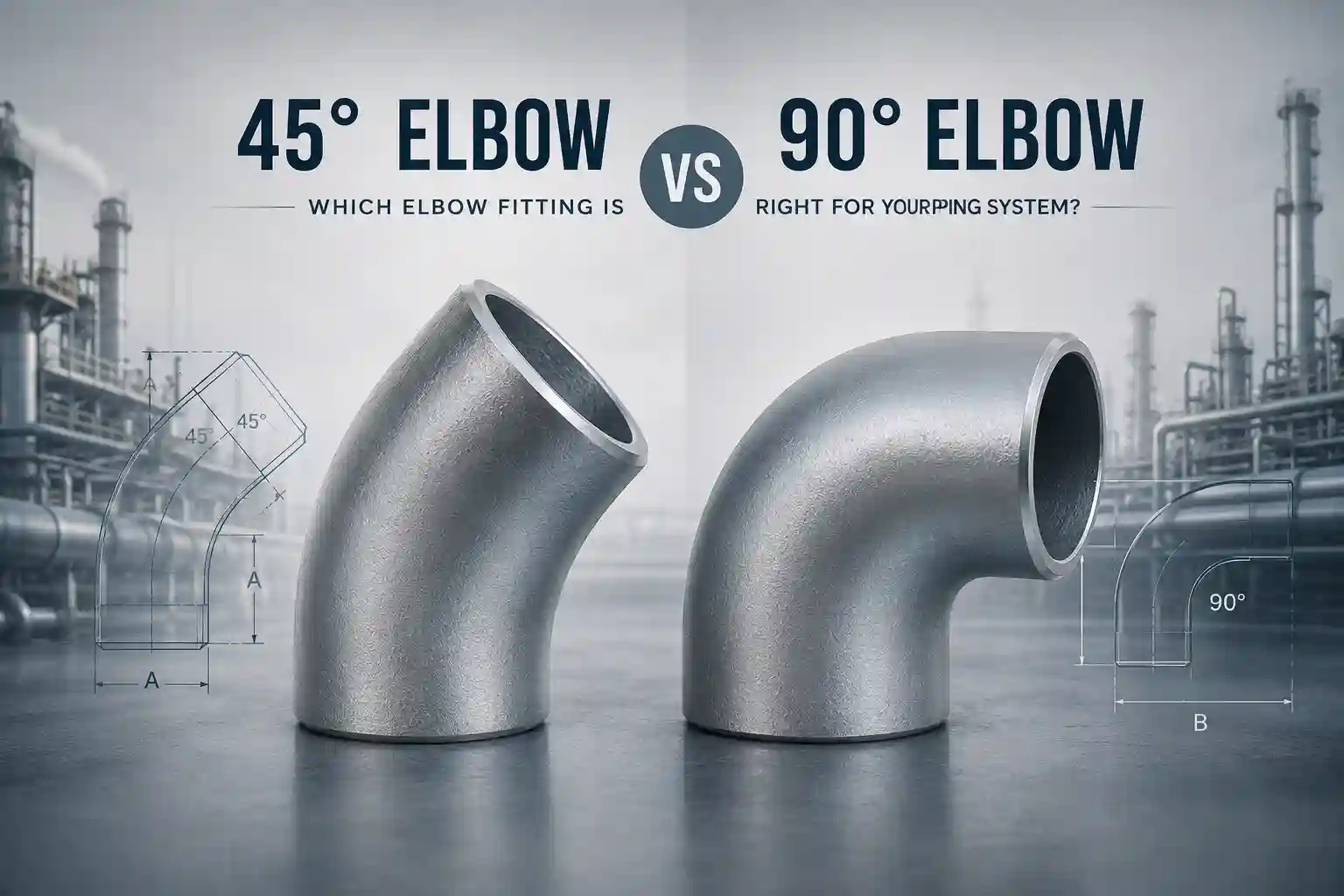
🧪 45 Degree vs 90 Degree Welded Elbow
Complete Engineering Selection Guide
Comprehensive Technical and Engineering Analysis · Updated: July 2026 · ⏱ Reading Time: 45 minutes
📌 Executive Summary
The selection between 45-degree and 90-degree elbows is one of the most critical decisions in industrial piping system design, directly impacting pressure drop, energy consumption, installation and maintenance costs, and overall system lifespan. Based on comprehensive analysis, the 90-degree elbow, despite higher pressure drop (resistance coefficient K approximately 0.9 to 1.5 times that of a 45-degree elbow), remains the dominant choice in most industrial projects due to complete directional change and higher design flexibility.
The 45-degree elbow is the superior choice in specific applications such as high-pressure systems, slurry pipelines, and energy-sensitive applications. CFD analysis and numerical calculations show that 45-degree elbows create 35 to 40 percent less pressure drop compared to 90-degree elbows of the same size and radius.
🔑 Final Recommendation: For space-constrained projects, use 90-degree SR elbows; for energy optimization and pressure drop reduction, use 45-degree LR elbows; and for general applications, use 90-degree LR elbows.
1. Introduction
Elbows are among the most important and widely used fittings in industrial piping systems, responsible for changing the direction of fluid flow. The selection of the appropriate elbow type and angle directly affects hydraulic system performance, energy consumption, installation and maintenance costs, and equipment lifespan.
This comprehensive article provides a scientific and engineering analysis of the differences between 45-degree and 90-degree elbows from various perspectives, using numerical calculations, CFD analysis, and practical experience to offer a complete guide for optimal selection.
The choice between 45-degree and 90-degree elbows is not purely an engineering decision; it must also consider project economics, space constraints, fluid type, operating conditions, and design standards.
2. ASME B16.9 and ASME B31.3 Standards
ASME B16.9 is the primary standard for dimensions, tolerances, and manufacturing requirements of butt-welding fittings including elbows. This standard specifies the dimensions and acceptable tolerances for elbow manufacturing.
ASME B31.3 is the process piping design standard that includes requirements for fitting selection, thickness calculation, and stress analysis. According to this standard, elbow selection must be based on design pressure, temperature, and fluid type.
| Size (NPS) | Outside Diameter (mm) | Center-to-End - LR (mm) | Center-to-End - SR (mm) | SCH40 Thickness (mm) |
|---|---|---|---|---|
| 2 | 60.3 | 76 | 51 | 3.91 |
| 3 | 88.9 | 95 | 64 | 5.49 |
| 4 | 114.3 | 114 | 76 | 6.02 |
| 6 | 168.3 | 152 | 102 | 7.11 |
| 8 | 219.1 | 203 | 133 | 8.18 |
| 10 | 273.1 | 254 | 168 | 9.27 |
| 12 | 323.9 | 305 | 203 | 9.53 |
📌 Source: ASME B16.9 – 2023
3. Fluid Dynamics in Elbows
Fluid flow through elbows creates complex changes in the flow field, including velocity changes, vortex formation, flow separation, and pressure drop. In 45-degree elbows, the milder angle results in less abrupt changes in the flow field, creating smaller vortices and less pressure drop.
3-1. Fundamental Equations
Bernoulli's Equation: $$P_1 + \frac{1}{2}ρV_1^2 + ρgz_1 = P_2 + \frac{1}{2}ρV_2^2 + ρgz_2 + h_L$$
Darcy-Weisbach Equation: $$h_L = f \frac{L}{D} \frac{V^2}{2g}$$
Reynolds Number: $$Re = \frac{ρVD}{μ}$$
3-2. Resistance Coefficient (K) in Elbows
The resistance coefficient (K) is the most important parameter in calculating local pressure drop in elbows. According to ASHRAE Fundamentals and Crane TP-410:
| Elbow Type | R/D Ratio | K Factor (Turbulent Flow) | Equivalent Length (L/D) |
|---|---|---|---|
| 45° LR | 1.5 | 0.25 | 18 |
| 45° SR | 1.0 | 0.35 | 25 |
| 90° LR | 1.5 | 0.60 | 45 |
| 90° SR | 1.0 | 0.90 | 68 |
| 180° (U-bend) | 1.5 | 1.20 | 90 |
📌 Source: Crane TP-410 & ASHRAE Fundamentals
The K factor for a 90-degree LR elbow (0.60) is more than 2.4 times that of a 45-degree LR elbow (0.25). This means the local pressure drop in a 90-degree elbow is significantly higher.
4. Pressure Drop Analysis
In this section, using standard formulas, we calculate the pressure drop through 45-degree and 90-degree elbows for various fluids.
4-1. Numerical Example: Water
Conditions: 4-inch pipe (SCH 40), flow rate 100 m³/h, velocity 2.5 m/s, temperature 20°C
| Elbow Type | K Factor | Pressure Drop (kPa) | Difference (%) |
|---|---|---|---|
| 45° LR | 0.25 | 0.78 | Reference |
| 45° SR | 0.35 | 1.09 | +39.7% |
| 90° LR | 0.60 | 1.87 | +139.7% |
| 90° SR | 0.90 | 2.81 | +260.3% |
4-2. Analysis for Natural Gas
Conditions: 6-inch pipe (SCH 40), flow rate 5000 m³/h, velocity 15 m/s, pressure 10 bar, temperature 30°C
| Elbow Type | K Factor | Pressure Drop (kPa) | Difference (%) |
|---|---|---|---|
| 45° LR | 0.25 | 4.2 | Reference |
| 45° SR | 0.35 | 5.9 | +40.5% |
| 90° LR | 0.60 | 10.1 | +140.5% |
| 90° SR | 0.90 | 15.2 | +261.9% |
As observed, the pressure drop difference between 45-degree and 90-degree elbows is significant for gaseous fluids as well, and this difference increases with higher velocities.
In high-pressure gas pipelines, using 45-degree elbows instead of 90-degree elbows can result in up to 15% energy savings in compressor power consumption.
5. Comprehensive Comparison Tables
5-1. General Comparison
| Criteria | 45° Elbow | 90° Elbow | Winner |
|---|---|---|---|
| Pressure Drop | Low | High (2.4x) | 45° |
| K Factor | 0.25 | 0.60 | 45° |
| Pump Energy Consumption | Low | High | 45° |
| Installation Space | Requires more space | Less space | 90° |
| Manufacturing Cost | Higher | Lower | 90° |
| Weight | Higher | Lower | 90° |
| Thermal Stress | Lower | Higher | 45° |
| Vortex Formation | Low | High | 45° |
| Suitable for Slurry | Excellent | Poor | 45° |
| Suitable for Steam | Excellent | Good | 45° |
| Maintenance Cost | Low | Medium | 45° |
| Service Life | High | Medium | 45° |
5-2. Cost Comparison
| Cost Type | 45° Elbow | 90° Elbow | Explanation |
|---|---|---|---|
| Initial Cost | 20% Higher | Lower | 45° elbow is more complex to manufacture |
| Installation Cost | Similar | Similar | Both are welded fittings |
| Energy Cost (5 years) | Lower | 20% Higher | Lower pressure drop = lower energy consumption |
| Maintenance Cost | Lower | Higher | Reduced wear and erosion |
| Total Lifecycle Cost | Lower | Higher | Including energy consumption |
6. Decision Matrix
| Application | Recommended Elbow | Reason | Priority |
|---|---|---|---|
| Crude Oil Pipelines | 45° LR | Reduced pressure drop and erosion | High |
| Natural Gas Pipelines | 45° LR | Reduced pressure drop and noise | High |
| Steam Lines | 45° LR | Reduced thermal stress | Very High |
| Municipal Water Lines | 90° LR | Lower cost, adequate space | Medium |
| Slurry Pipelines | 45° LR | Reduced wear and clogging | Very High |
| Power Plants | 45° LR / 90° LR | Based on pressure and temperature | High |
| Petrochemical Plants | 45° LR | Reduced pressure drop and safety | Very High |
| Fire Protection Systems | 90° LR | Standard and lower cost | Medium |
| Hydrogen Pipelines | 45° LR | Reduced turbulence and leakage | Very High |
| LNG Facilities | 45° LR | Reduced pressure drop at low temperature | Very High |
| Food Industry | 90° LR | Hygienic standards | Medium |
| Pharmaceutical Industry | 45° LR | Reduced turbulence and contamination | High |
| Seawater Intake Lines | 45° LR | Reduced corrosion and erosion | High |
| HVAC Systems | 90° LR | Less space and lower cost | Medium |
7. Frequently Asked Questions (FAQ)
📚 References
- ASME B16.9-2023. Factory-Made Wrought Butt-Welding Fittings. New York: ASME.
- ASME B31.3-2022. Process Piping. New York: ASME.
- ASME B36.10M-2022. Welded and Seamless Wrought Steel Pipe. New York: ASME.
- Crane Co. (2018). Flow of Fluids Through Valves, Fittings, and Pipe. Technical Paper No. 410.
- ASHRAE (2021). ASHRAE Handbook – Fundamentals. Atlanta: ASHRAE.
- Perry, R.H., & Green, D.W. (2019). Perry's Chemical Engineers' Handbook. 9th Edition. McGraw-Hill.
- GPSA (2020). Engineering Data Book. 14th Edition. Gas Processors Suppliers Association.
- White, F.M. (2021). Fluid Mechanics. 9th Edition. McGraw-Hill.
- Idelchik, I.E. (2019). Handbook of Hydraulic Resistance. 4th Edition. Begell House.
- World Steel Association. (2025). Steel Statistical Yearbook. Brussels: World Steel Association.
- Iran Etessal Asia. (2026). ASME B16.9 Standards Guide. Tehran: Iran Etessal Asia.
✅ Based on ASME B16.9 and ASME B31.3 Standards | Iran Etessal Asia
🌍 International Presence
Iran Etessal Asia — Exporting to the Caucasus & CIS Countries
🌐 Focus: Caucasus, Central Asia & CIS
Iran Etessal Asia is a leading manufacturer and exporter of butt weld fittings and piping components. With a strategic focus on the Caucasus region and CIS countries, we serve key markets across the region.
- Products: Elbows, Tees, Reducers, Caps
- Standards: ASME B16.9, ASTM A234, MSS SP-75
- Materials: Carbon Steel, Stainless, Alloy, Duplex
- Sizes: ½" to 48" (DN15 to DN1200)